How to Find a Graphic Designer for a T-shirt?
If you want to launch custom tees, the first roadblock is usually the same: how do you find a graphic designer for a T-shirt who actually delivers? A bad design wastes your sampling budget, delays your production schedule, and can sink a whole product line. I've been through this many times, so let me share what actually works.
To find a graphic designer for a T-shirt, you have two proven paths: hire a freelance designer on platforms like Upwork or Fiverr, or generate the artwork yourself using AI tools. Freelancers guarantee usable, print-ready files at a higher cost. AI is far cheaper, but the output quality depends heavily on your prompting skills.
If you're still planning the business itself, see our guide on how to start an online T-shirt store.
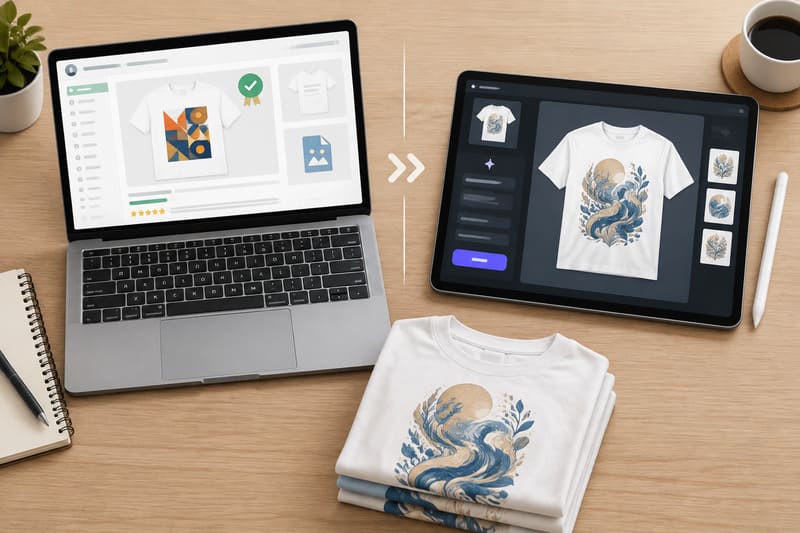
So which path should you take? It depends on your budget, your timeline, and honestly, how comfortable you are with new tools. Below, I'll walk through both methods step by step, share my personal experience with each, and tell you exactly where each one shines and where it falls apart.
What's the old way to find a graphic designer for a T-shirt?
You need artwork, but you have zero design skills. Meanwhile, your launch date is getting closer every day. The pressure builds fast. Luckily, the classic solution has been around for years, and it still works reliably.
The old way is simple: post your project on a freelance talent platform like Upwork or Fiverr. These sites host thousands of freelancers offering all kinds of skills, including plenty of specialists in T-shirt graphic design.[^1] You post a job, review applicants, and pick the best fit.
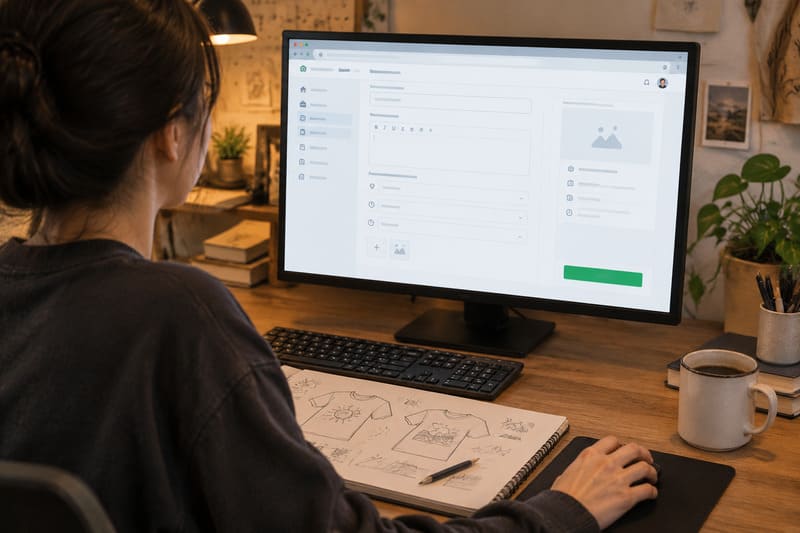
The process is honestly very simple. Here's how I do it, step by step:
- Register an account. Go to Upwork or Fiverr and sign up following the site's prompts. It takes a few minutes.
- Post your requirement. Describe your T-shirt design idea. Be specific: style, colors, theme, where it goes on the shirt, and what file format you need.
- Wait for applicants. Once your job goes live, freelancers will start contacting you. On a popular platform, you can get responses within hours.[^2]
- Review their portfolios. This step matters most. Ask each candidate to show previous work. Their past T-shirt designs tell you whether they can actually handle your project. Don't skip this.
- Compare pricing. Ask each candidate what they charge. Compare several applicants side by side before you decide.
- Pick your designer and start. Choose the one whose portfolio, price, and communication style fit you best.
A few practical tips from my own experience:
- Ask for source files. You want editable files (AI, PSD, or vector formats), not just a JPG. Your garment factory will need proper files for screen printing or DTF[^3].
- Check their response speed early. If a freelancer replies slowly during the hiring stage, they'll reply even slower once you've paid. I learned this the hard way on one project where a designer disappeared for four days mid-revision.
- Agree on revision rounds upfront. Two or three included revisions is a fair standard.
The biggest advantage of this method: a good freelancer will definitely produce something usable. The output is predictable.
Upwork or Fiverr — which platform is better for T-shirt design?
Both platforms look similar on the surface. Both have huge talent pools. So most people just pick one at random, and sometimes they regret it. The differences are real, and they affect what you get back.
Based on my personal experience, I recommend Upwork for T-shirt design work. Freelancers on Upwork generally submit higher-quality work. They do charge more than Fiverr freelancers, but in my experience, you get what you pay for. The extra cost is usually worth it.
Let me break down the comparison honestly. This is just my personal take, but I've hired on both platforms, so it comes from real projects, not theory.
| Factor | Upwork | Fiverr |
|---|---|---|
| Typical quality | Higher, more consistent | Mixed, big variance |
| Price level | Higher | Lower, budget-friendly |
| Hiring model | You post a job, designers apply | You browse pre-made "gigs" |
| Best for | Brand-level, detailed projects | Quick, simple, low-budget designs |
| Communication | Usually more professional | Varies a lot by seller |
A few more thoughts on each:
When Fiverr makes sense
Fiverr is fine if your design is simple. Think basic text layouts or a straightforward logo placement. Prices can start very low, and turnaround is often fast. For a one-off promotional tee where the artwork isn't complicated, Fiverr can save you money.
When Upwork is worth the extra money
If your T-shirt design will represent a brand, go with Upwork. In my experience, the difference shows up in the details: cleaner vector lines, correct color separation for screen printing, and better file handoff[^4]. One time I paid roughly double on Upwork versus a Fiverr quote, and the Upwork designer delivered print-ready files that my production team could use immediately with zero rework. The Fiverr file from a previous project had needed cleanup before it could even go to the printer.
Bottom line: 一分价钱一分货 — as we say, you get what you pay for. For anything serious, I'd start on Upwork.
Can AI replace a graphic designer for a T-shirt?
Here's the thing that changes everything. Hiring a human takes time and money, and you depend on someone else's schedule. What if you could skip all of that? Well, in many cases now, you can.
Yes — AI can now generate T-shirt graphics for you[^5], and this is the new way. It's 2026, and ChatGPT just released its new Astra model in early September[^6], with people already claiming the AGI era has arrived[^7]. You describe what you want, and AI generates the graphic file directly on your own computer.
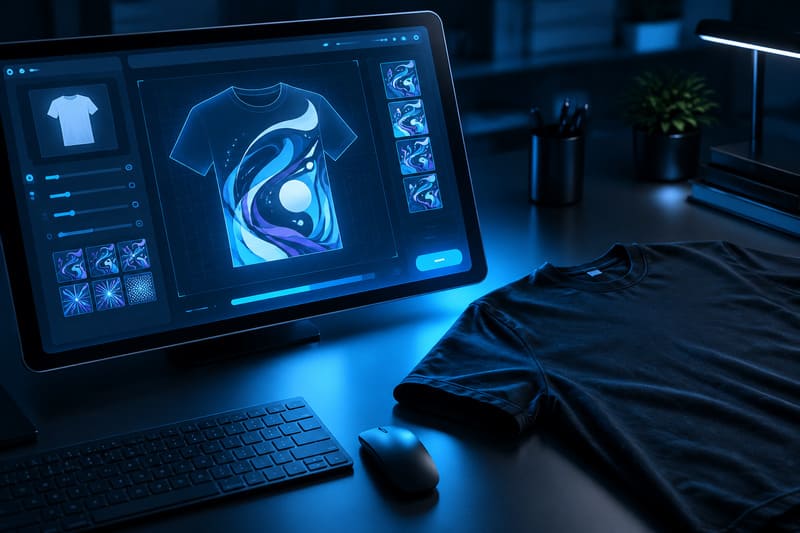
Let me be direct about this: I believe AI generation will become the mainstream way of working in the future.[^8] The reasons are pretty obvious once you try it:
- No dependence on anyone. You don't wait for a freelancer to wake up in another time zone. You don't chase anyone for revisions. Everything happens on your own computer, whenever you want.
- The cost is dramatically lower.[^9] Compared to hiring a designer, AI generation is cheap. Honestly, it's not even a fair fight — it's what I'd call a total knockout on price. What might cost you $100–$300 from a freelancer can cost you a few dollars in AI subscription fees.
- Instant iteration. Don't like the result? Generate ten more versions in minutes.[^10] A human designer would charge you for that many revisions.
But — and this is a big but — using AI to generate graphic files has a real difficulty. The quality of what you get depends entirely on:
- How well you understand AI tools. Different tools have different strengths. You need to know which one fits your task.
- How you express your requirements. This is the core skill. You must describe your idea in a way the AI can accurately recognize and understand. Vague prompts produce vague designs.[^11]
- Whether the output is actually usable. An image that looks nice on screen isn't automatically print-ready. Resolution, color mode, and file format all matter for actual T-shirt production.[^12]
This prompting-and-evaluation skill is, right now, the single biggest challenge with the AI approach. I've seen people generate fifty images and still not get one usable file, simply because they couldn't articulate what they wanted. Meanwhile, someone skilled gets a great result in one try.
So AI is powerful, but it's not magic. Your skill level is the ceiling.
Which way should you choose to get your T-shirt design done?
Two methods, two very different trade-offs. Pick wrong, and you either overspend or end up with files you can't use. So let's put them side by side and make this decision easy.
My honest summary: both methods will coexist for a while. Freelancers guarantee a usable result at a higher price. AI costs almost nothing, but the output might not be what you want, or might not be usable at all. Choose based on your budget, skills, and how critical the design is.
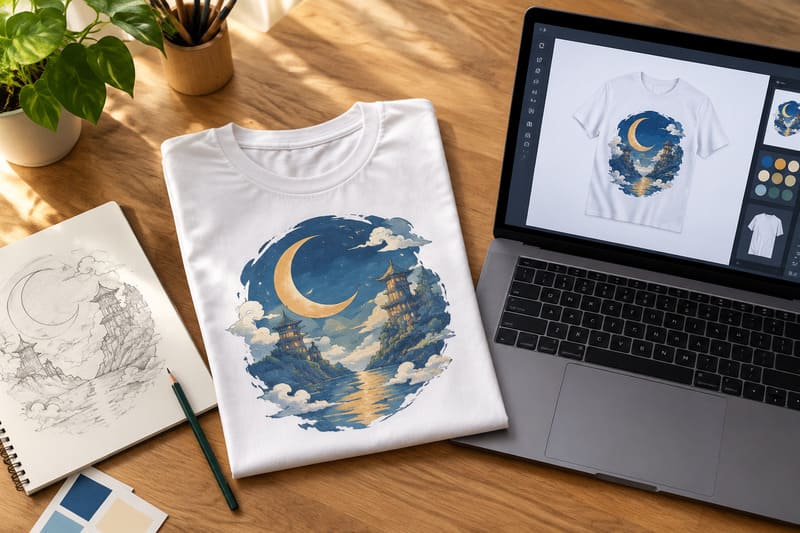
Here's the full comparison:
| Old way: Freelancer | New way: AI generation | |
|---|---|---|
| Cost | Higher ($50–$500+ per design) | Very low (a few dollars or less) |
| Reliability | High — a good designer will definitely produce what you want | Uncertain — output may not match your vision or may not be usable |
| Speed | Days, depending on the designer | Minutes |
| Skill required from you | Low — just communicate clearly | High — prompting skill is the bottleneck |
| Print-ready files | Yes, if you request source files | Not always — often needs conversion or cleanup |
My practical recommendation
- Choose a freelancer (Upwork) if the design represents your brand, if you need guaranteed print-ready files, or if you have zero patience for trial and error. The certainty is worth the money.
- Choose AI if your budget is tight, your design concept is simple, and you're willing to invest time learning how to prompt properly. The cost savings are massive once you get good at it.
- Or combine both. Honestly, this is what I do now. I use AI to explore concepts and generate rough directions quickly and cheaply. Then, once I know exactly what I want, I hand it to a freelancer to refine into a clean, production-ready file. You get the best of both worlds: cheap ideation plus guaranteed usability.
One more production note from my side of the business: whichever route you take, always confirm the final file requirements with your garment manufacturer before you finalize the design. A quick check upfront saves you from redoing artwork later.
Frequently Asked Questions
How much does a T-shirt graphic designer cost on Upwork or Fiverr?
It varies widely. On Fiverr, simple designs can start around $10–$30. On Upwork, expect roughly $50–$300+ depending on complexity and the designer's experience. In my experience, higher prices generally correlate with better, more print-ready results, so budget according to how important the design is.
What file format should I ask a T-shirt designer for?
Ask for vector files (AI, EPS, or SVG) plus a high-resolution PNG with a transparent background. Vector files scale without losing quality and work best for screen printing and DTF. Always request the editable source file, not just a flat image.
Is AI-generated T-shirt art good enough for actual printing?
Yes, but always check whether the file is actually print-ready. A graphic that looks good on screen may still have problems with resolution, file format, colors, or transparency.
Before production, send the file to your T-shirt manufacturer and confirm that it meets the requirements for your printing method.
Conclusion
There are currently two practical ways to get a T-shirt graphic designed.
The traditional way is to hire a freelancer through platforms like Upwork or Fiverr. It costs more, but the result is generally more predictable. From my own experience, I prefer Upwork because the overall quality tends to be better.
The newer way is to use AI. It's much cheaper, faster, and doesn't require you to depend on another person. The challenge is that the quality of the result depends heavily on how well you understand AI and how clearly you can communicate what you want.
So for now, I think both methods will continue to coexist. If you want a more reliable result, hire a good freelancer. If you want lower costs and more control, learn how to use AI.
Either way, always make sure the final graphic file is actually suitable for T-shirt production.
[^1]: "upwork inc.", https://www.sec.gov/Archives/edgar/data/1627475/000162747519000007/upwk-12312018x10k.htm. Company annual reports and marketplace disclosures describe Upwork and Fiverr as large online labor platforms with substantial freelance participation and design-related service categories; these figures support the article's general claim about broad designer availability but do not prove the number of T-shirt specialists specifically. Evidence role: general_support; source type: institution. Supports: The source should document the scale of Upwork and Fiverr as freelance marketplaces and, if available, the presence of design-related service categories.. Scope note: Marketplace-wide figures are contextual and may not isolate T-shirt graphic designers. [^2]: "Demand for Online Gig Work Rapidly Rising in Developing ...", https://www.worldbank.org/en/news/press-release/2023/09/07/demand-for-online-gig-work-rapidly-rising-in-developing-countries. Research on online labor platforms finds that digital marketplaces can reduce search frictions and accelerate matching between buyers and freelance workers, supporting the article's expectation of relatively fast applicant responses while not guaranteeing responses within a specific number of hours. Evidence role: general_support; source type: paper. Supports: The source should show that online labor platforms are designed to reduce search and matching time between clients and freelancers.. Scope note: The evidence is about platform matching generally, not a guaranteed response time for T-shirt design jobs. [^3]: "How to Prepare Your Artwork for Screen Printing", https://www.frenchpresscustom.com/blog/how-to-prepare-your-artwork-for-screen-printing-complete-guide. Technical guidance on garment-print artwork preparation explains that production methods such as screen printing and DTF require files with appropriate resolution, separations, and editable or production-ready formats, supporting the need for more than a simple preview image. Evidence role: mechanism; source type: education. Supports: The source should explain why garment printing workflows require adequate resolution, separations, and/or editable vector or layered files.. Scope note: Specific file requirements vary by printer, ink system, substrate, and production workflow. [^4]: "How to Prepare Your Artwork for Screen Printing", https://www.frenchpresscustom.com/blog/how-to-prepare-your-artwork-for-screen-printing-complete-guide. Print-production guidance explains that screen printing commonly relies on clean artwork and separate color information for stencil or screen preparation, supporting the article's claim that vector quality, color separation, and file handoff affect production usability. Evidence role: mechanism; source type: education. Supports: The source should explain the role of vector artwork and color separations in preparing designs for screen printing.. Scope note: The source would support the technical workflow, not the article's comparative judgment about Upwork versus Fiverr designers. [^5]: "Text-to-image Diffusion Models in Generative AI: A Survey", https://arxiv.org/abs/2303.07909. Research on text-to-image diffusion models shows that generative AI systems can synthesize images from natural-language prompts, supporting the article's general claim that AI can generate graphic concepts for T-shirt artwork. Evidence role: general_support; source type: paper. Supports: The source should establish that text-to-image AI systems can generate images from natural-language prompts.. Scope note: The evidence establishes image-generation capability, not that outputs are automatically print-ready or commercially usable. [^6]: "GPT-6 Astra", https://en.wikipedia.org/wiki/GPT-6_Astra. An official OpenAI announcement or release note should be cited to verify the claimed release of a ChatGPT model named Astra in early September; without such documentation, the statement remains an unsupported product-release claim. Evidence role: historical_context; source type: institution. Supports: The source should directly verify the model name, release timing, and relationship to ChatGPT.. Scope note: If no official release note exists, the article should not present this as a verified fact. [^7]: "Artificial general intelligence", https://en.wikipedia.org/wiki/Artificial_general_intelligence. AI policy and research surveys document ongoing disagreement about whether current systems meet definitions of artificial general intelligence, supporting the article's observation that some people make AGI-era claims while clarifying that this is not a settled expert consensus. Evidence role: expert_consensus; source type: research. Supports: The source should document that AGI claims are debated and distinguish public claims from expert consensus.. Scope note: This would contextualize the controversy rather than verify that AGI has actually arrived. [^8]: "The 2026 AI Index Report | Stanford HAI", https://hai.stanford.edu/ai-index/2026-ai-index-report. Research and industry surveys on generative AI adoption show increasing use of AI tools in knowledge and creative work, providing contextual support for the prediction that AI-assisted generation may become a mainstream workflow. Evidence role: expert_consensus; source type: research. Supports: The source should show evidence of growing generative AI adoption in creative or workplace workflows.. Scope note: Adoption trends support plausibility but do not prove that AI generation will become the dominant method for T-shirt design specifically. [^9]: "Graphic Designers : Occupational Outlook Handbook", https://www.bls.gov/ooh/arts-and-design/graphic-designers.htm. Labor-rate surveys and AI subscription pricing data indicate that a commissioned graphic-design project often costs more than the marginal cost of generating multiple AI images under a subscription plan, supporting the article's cost comparison in general terms. Evidence role: statistic; source type: research. Supports: The source should provide comparative context for freelance graphic-design costs and the lower marginal cost of AI image generation.. Scope note: Actual costs depend on design complexity, licensing terms, subscription limits, and any post-processing needed for production. [^10]: "[2501.09732] Inference-Time Scaling for Diffusion Models ...", https://arxiv.org/abs/2501.09732. Studies and technical descriptions of text-to-image systems report that trained generative models can produce images through automated inference, supporting the claim that multiple visual variations can be generated rapidly compared with manual redesign. Evidence role: mechanism; source type: paper. Supports: The source should show that text-to-image systems can generate images quickly enough to support rapid iteration.. Scope note: Exact generation time varies by model, hardware, image size, queueing, and service limits. [^11]: "An Exploration of Default Images in Text-to-Image Generation", https://arxiv.org/html/2505.09166v2. Research on prompt engineering for text-to-image models shows that prompt wording, specificity, and constraints influence generated outputs, supporting the article's claim that vague prompts tend to produce less targeted designs. Evidence role: mechanism; source type: paper. Supports: The source should explain that the wording and specificity of prompts influence generated image outputs.. Scope note: Prompt quality is one factor among others, including model capability, training data, randomness, and post-processing. [^12]: "Artwork Specifications | Document Solutions", https://documentsolutions.utexas.edu/printing/artwork-specifications. Print-production guidance explains that resolution, color mode, and file format affect image fidelity and production compatibility, supporting the article's warning that a screen-ready image may still be unsuitable for garment printing. Evidence role: mechanism; source type: education. Supports: The source should explain how image resolution, color mode, and file format affect print output.. Scope note: Requirements differ across screen printing, DTF, DTG, sublimation, and individual manufacturers.