If you have ever wondered how T-shirt printing machines actually work, you are not alone. Many buyers approve a logo design, place an order, and then get surprised by the price or the print quality. The wrong machine choice can waste time and money. So let me walk you through how each type of machine works, based on what I see on our factory floor every day.
T-shirt printing machines work in four main ways. Screen printing machines push ink through a screen, one color at a time. DTF machines print the design onto a film, then heat-press it onto the shirt. DTG machines print ink directly into the fabric. Sublimation machines print onto transfer paper, then transfer the design onto whole rolls of fabric using heat.
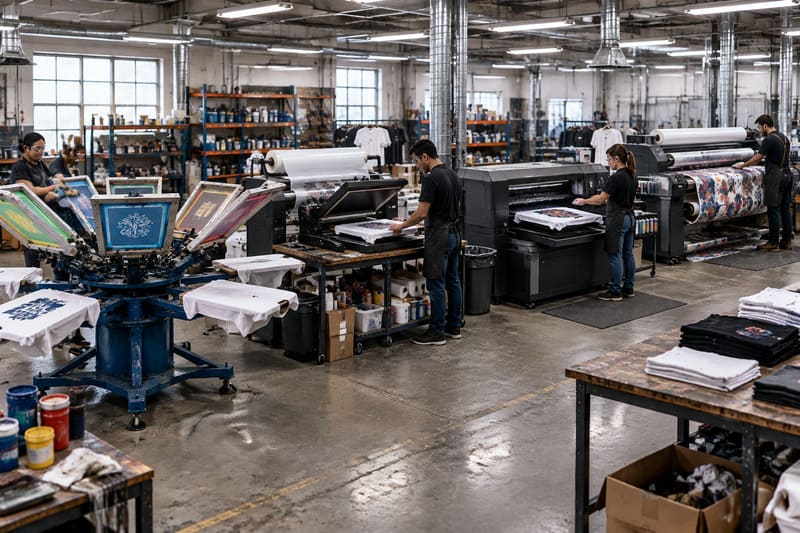
Each of these four machines has a sweet spot. Some are cheap for simple logos. Some handle unlimited colors. Some cover the entire shirt. Below, I will break down how each one works, what it costs, and when you should choose it.
How does a screen printing machine work?
You send a simple two-color logo to a factory. The quote comes back low, and the print lasts for years. Then you send a ten-color design, and the quote suddenly explodes. Why? The answer is in how screen printing machines work.
Screen printing machines push ink through a fine screen onto the T-shirt, one layer at a time. Each color needs its own separate screen.[^1] The machine (or an operator, if done by hand) applies color after color until the full logo is built up on the fabric.
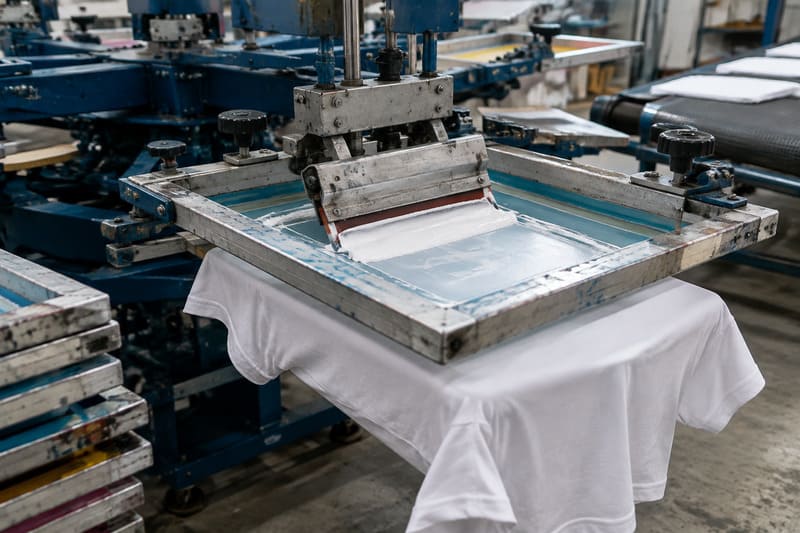
The key point is simple: one color equals one screen. That single fact drives almost every cost decision in screen printing.
In our workshop, screen printing can be done by hand on a rotary carousel or by an automatic machine. Either way, the process is the same:
- Make a screen for each color. The design is burned onto a screen, which blocks ink everywhere except the logo area.
- Lay the T-shirt flat on the printing platen.
- Squeegee the first color through the first screen.
- Repeat for every color, aligning each screen precisely so the layers line up.
- Cure the ink with heat so it bonds to the fabric.
Based on the jobs we handle in our workshop, screen printing usually makes the most sense in the following situations:
- Best for: Logos or text in a fixed position, with three colors or fewer.
- Avoid when: Your design has ten or more colors. Ten colors means ten screens, and screens are not cheap. The setup cost alone can kill the deal.
- The payoff: For simple designs, the print quality is excellent, the cost per piece is very low at volume, and durability is outstanding.
I once had a client insist on screen printing a photo-style design with a dozen color tones. I had to talk them out of it. We moved the job to DTF, and they saved a serious amount of money. Which brings me to the next machine.
How do DTF printing machines work?
So what do you do when your logo has 15 colors and screen printing costs too much? This is exactly the gap that DTF was designed to fill. DTF printing machines have become one of the most popular options I see in T-shirt production today.
DTF (direct-to-film) machines first print the full design onto a special film. Then a heat press transfers the design from the film onto the T-shirt.[^2] Unlike screen printing, DTF does not require a separate screen for each color, so adding more colors usually does not create the same setup-cost increase.[^3]
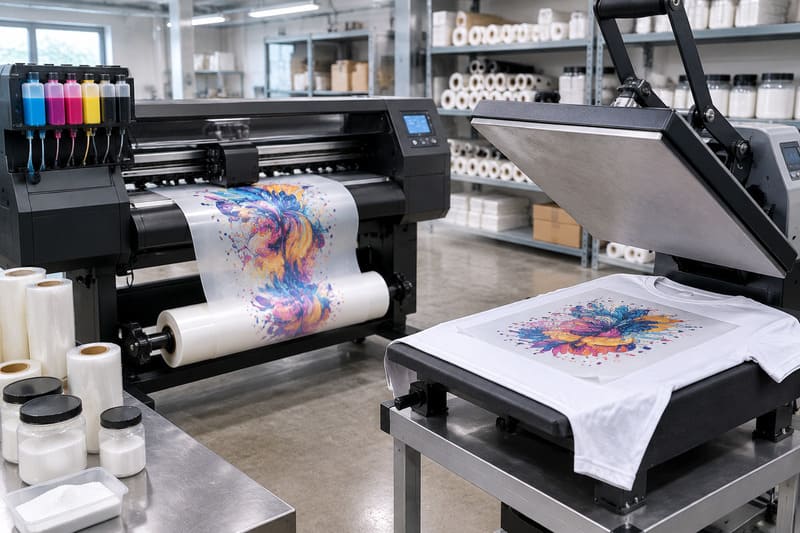
The DTF process has two clear stages:
- Print stage: A digital printer prints your full-color design onto a film. An adhesive powder is applied to the wet ink.
- Transfer stage: The film is placed on the T-shirt, and a heat press applies heat and pressure. The design peels off the film and bonds onto the shirt.
The pricing logic is almost the opposite of screen printing:
| Cost factor | Screen printing | DTF |
|---|---|---|
| Number of colors | Big impact (one screen per color) | Much less impact than screen printing |
| Print size | Small impact | Main cost driver |
| Setup cost | High (screens must be made) | Low |
| Best design type | Simple logos, 1–3 colors | Multi-color, detailed designs |
So a 10cm × 10cm logo and a 40cm × 40cm print will have very different DTF costs, even if they use the exact same colors. Size is everything here.
In practice, I recommend DTF when a buyer has a colorful, detailed logo but does not want to pay for a dozen screens. It is affordable, the color reproduction is sharp, and it works well on the cotton and cotton-blend fabrics we use for T-shirts, polos, and hoodies. For most multi-color logo jobs, DTF gives the best balance of cost and quality.
How do DTG machines print directly on T-shirts?
Some designs demand the softest possible hand feel and photo-level detail. Film transfers sit on top of the fabric, and some buyers can feel that layer. If that bothers your end customer, DTG is the machine built to solve it — at a price.
DTG (direct-to-garment) machines print ink directly into the T-shirt fibers, like an inkjet printer for fabric. The shirt is first sprayed with a pre-treatment liquid, then placed flat inside the DTG machine, which prints the design straight onto the garment.
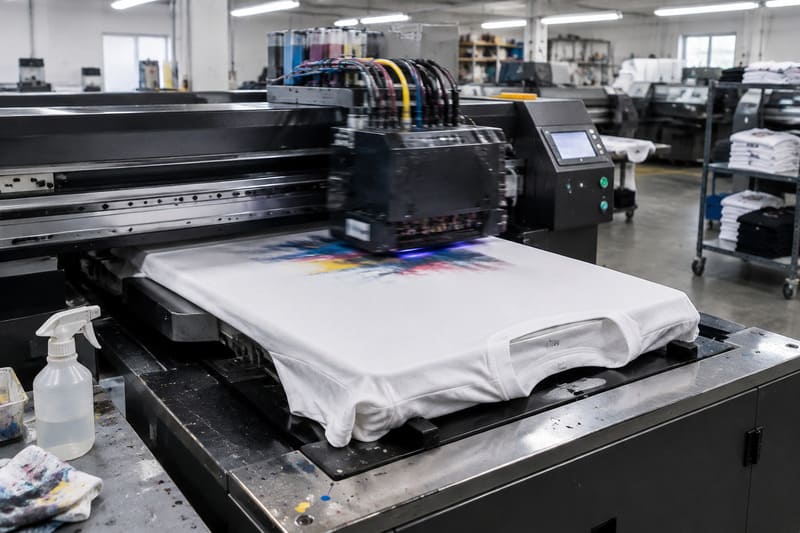
Here is what actually happens on the production line:
- Pre-treatment. The operator sprays a treatment liquid onto the print area of the finished T-shirt. This helps the ink bond to the fibers and keeps colors vivid.[^4]
- Loading. The shirt is stretched flat on the machine's platen, so the print surface is smooth.
- Printing. The DTG machine prints the design directly onto the fabric, just like a paper printer, but with textile inks.
- Curing. Heat sets the ink permanently into the fibers.
The result is genuinely impressive. Because DTG prints directly onto the fabric rather than transferring a printed film onto it, the finished print can have a softer hand feel, breathe with the fabric, and handle fine gradients and photographic detail beautifully. Of the four methods, DTG probably gives the most premium finished look for detailed artwork.
The trade-off is cost. DTG is the most expensive of the four printing methods. The machines are costly, the inks are costly, and the pre-treatment step adds labor to every single piece. When I quote DTG jobs, buyers are sometimes shocked at the per-piece price compared to DTF.
So my rule of thumb for procurement teams:
- Choose DTG when print quality and hand feel are the top priority, and your product's retail price can absorb the cost. Think premium fashion lines or high-end merch.
- Skip DTG for promotional giveaways or price-sensitive programs. DTF will get you 90% of the way there at a fraction of the cost.
How do sublimation machines handle all-over prints?
Now imagine a T-shirt where the print covers the entire garment — front, back, sleeves, everything — maybe with smooth gradient colors flowing across the seams. For true all-over prints on polyester garments, sublimation is often the most practical production method. This is where the biggest machine of them all comes in.
Sublimation machines print the design onto heat-transfer paper first. Then, using heat, the design sublimates and transfers onto entire rolls of fabric. The printed fabric is then cut into garment panels and sewn into finished T-shirts.
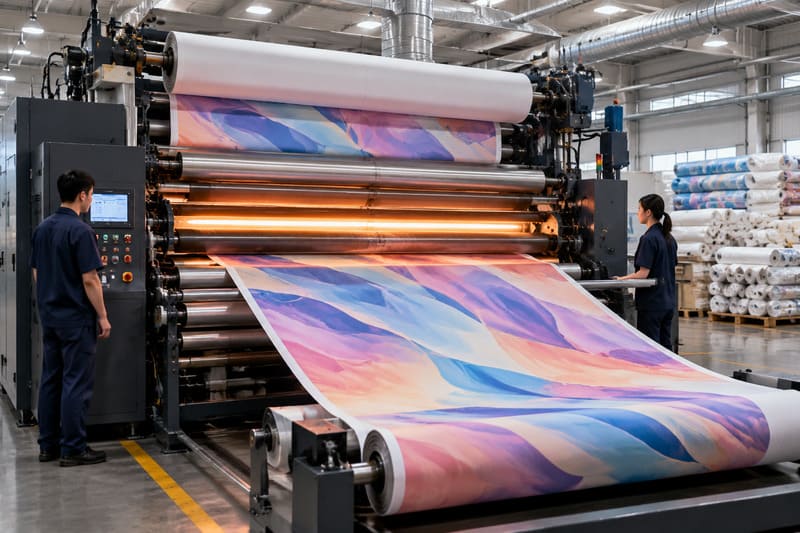
Sublimation flips the whole production sequence. With the other three methods, you print on a shirt or a cut piece. With sublimation, the roll of fabric is the canvas, and printing happens before the garment is even cut. Here is the flow we use:
- Print the transfer paper. The full design — laid out panel by panel, matching each cutting piece of the T-shirt — is printed onto heat-transfer paper.
- Heat transfer onto fabric. The paper and the fabric roll pass through a heated calender together. The heat turns the ink into gas, and it bonds permanently into the fabric.[^5]
- Cut the panels. The garment factory cuts out each pre-printed panel exactly along the printed layout.
- Sew the garment. The panels are assembled into the finished T-shirt, with the design flowing across the whole piece.
When should you choose sublimation? In my experience, it is the right answer when:
- The design is a full, all-over print covering the whole shirt
- The design includes gradient colors blending across large areas
- You want vivid, permanent color that never cracks or peels, because the ink becomes part of the fabric itself
One important note: sublimation works best on polyester and polyester-rich fabrics, since the ink bonds with synthetic fibers. That is a fabric decision your supplier should raise with you at the very start of the project — not after sampling. Transparency on these details early on saves everyone from expensive surprises later.
What do all T-shirt printing machines need before printing starts?
Here is a step that trips up more projects than any machine ever does. A buyer sends a blurry JPG screenshot of their logo and expects a sharp print. Then sampling gets delayed, emails go back and forth, and everyone gets frustrated. It is completely avoidable.
For the best printing result, customers should provide production-ready, high-resolution artwork. Vector files such as AI, EPS, or PDF are ideal for logos and simple graphics, while high-resolution raster files can also work for DTF, DTG, and sublimation printing.
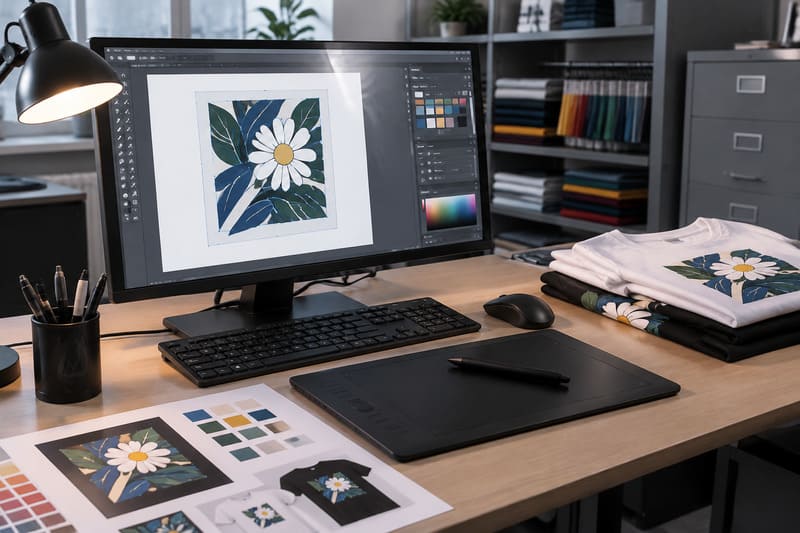
Why does this matter so much? A quick breakdown:
- Vector files scale infinitely. Whether we print your logo at 10cm or blow it up to a 40cm chest print, the edges stay razor sharp. A pixel image (JPG, PNG screenshot) turns blurry when enlarged.
- Vector files give the printer clean color information. This is especially important for screen printing, where every color may need to be separated into its own screen. A properly prepared file makes that separation much easier and avoids unnecessary mistakes during sampling.
- They also make production faster. If the artwork is ready when you send the inquiry, the factory can check the design, recommend the right printing method, and calculate the printing cost much more accurately.
If you do not have a vector file yet, that does not necessarily mean the project has to stop. In many cases, a graphic designer can convert your existing artwork into a usable vector file. But I always recommend getting this done before sampling starts, rather than waiting until the factory is ready to print.
Once the artwork is ready, the next question is simply which machine makes the most sense for your design.
Which T-shirt printing machine should you choose?
After looking at all four methods, the choice is actually not as complicated as it may seem.
If you have a simple logo or text with three colors or fewer, screen printing is usually the first method I would consider. The setup requires separate screens, but once those screens are made, the cost can be very competitive, especially when the order quantity is large.
If your design has many colors but only covers a certain area of the T-shirt, DTF is often the more practical choice. You do not need to worry about paying for a separate screen for every color. Instead, the main thing affecting the price is the size of the print.
If you want a premium print with a very soft hand feel and detailed artwork, DTG can give an excellent result. Just remember that you are paying for that quality. Among these four methods, DTG is generally the most expensive option.
And if your design covers the entire T-shirt, especially when it includes gradients, large areas of color, or an all-over pattern, sublimation is usually the method to look at. Instead of printing on a finished garment, the design is printed onto the fabric first, and the printed panels are then cut and sewn into the T-shirt.
For buyers comparing the four methods, the basic choice looks like this:
| Your design | Printing method to consider |
|---|---|
| Simple logo or text, 1–3 colors | Screen printing |
| Multi-color logo or detailed graphic | DTF |
| Premium detailed print with soft hand feel | DTG |
| Full T-shirt / all-over print / gradients | Sublimation |
Of course, this is not an absolute rule. Your order quantity, fabric, print size, target price, and required quality can all change the final decision. But as a starting point, this table will get you pretty close.
Conclusion
So, how do T-shirt printing machines work?
The answer depends entirely on the printing method.
Screen printing pushes ink through separate screens one color at a time. DTF prints the complete design onto film and then transfers it onto the T-shirt with heat. DTG prints ink directly into the garment fibers. And sublimation prints the design onto transfer paper first, then uses heat to transfer it onto rolls of fabric before the garment is cut and sewn.
There is no single printing machine that is best for every T-shirt.
A three-color chest logo and a full-shirt gradient design are two completely different jobs, so it would not make sense to produce them with the same machine.
That is why, when you send a T-shirt project to a factory, do not just ask, “How much does printing cost?”
Send them your vector artwork, tell them the print size, fabric, order quantity, and where the design needs to appear on the garment. With that information, the factory can recommend the printing method that gives you the right balance between cost, appearance, and quality.
And in most cases, choosing the right printing machine at the beginning is much cheaper than discovering you chose the wrong one after the sample is already made.
[^1]: "Screen Printing Process", ScreenPrinting.com, https://www.screenprinting.com/pages/screen-printing-process-sp230084. The process guide explains how ink is applied to the screen and pushed through the mesh onto the printing surface using a squeegee.
[^2]: "DTF vs Screen Print vs HTV: Which Full Color Transfer Do I Use?", STAHLS', https://blog.stahls.com/dtf-vs-screen-print-vs-htv/. STAHLS' describes direct-to-film transfers as being printed directly onto a PET carrier, backed with adhesive, and applied to garments as a heat-transfer decoration method.
[^3]: "Digital Versus Screen Printing: How do I make a cost comparison?", AATCC, https://www.aatcc.org/news-read/insights/digital-versus-screen-printing-how-do-i-make-a-cost-comparison. The comparison explains that screen printing requires additional screens as the number of colors increases, while digital textile printing does not require separate screens for each color.
[^4]: "One-Bath Pretreatment for Enhanced Color Yield of Ink-Jet Prints Using Reactive Inks", PMC, https://pmc.ncbi.nlm.nih.gov/articles/PMC6150267/. Textile-printing research shows that pretreatment of cotton before inkjet printing can improve dye fixation, color yield, and print quality.
[^5]: "Exploration on ability of printable modified papers for the application in heat sublimation transfer printing of polyester fabric", Scientific Reports / PMC, https://pmc.ncbi.nlm.nih.gov/articles/PMC10121600/. The study describes sublimation heat-transfer printing in which disperse dye on transfer paper changes into a gaseous state under heat and is absorbed into polyester fabric.