If you've ever placed an order with a clothing factory, you know the frustration. You send your files, you wait, and everything behind the factory gate feels like a black box. That mystery creates risk — wrong sizes, misplaced logos, missed deadlines. The fix starts with understanding exactly how a factory turns fabric into finished garments.
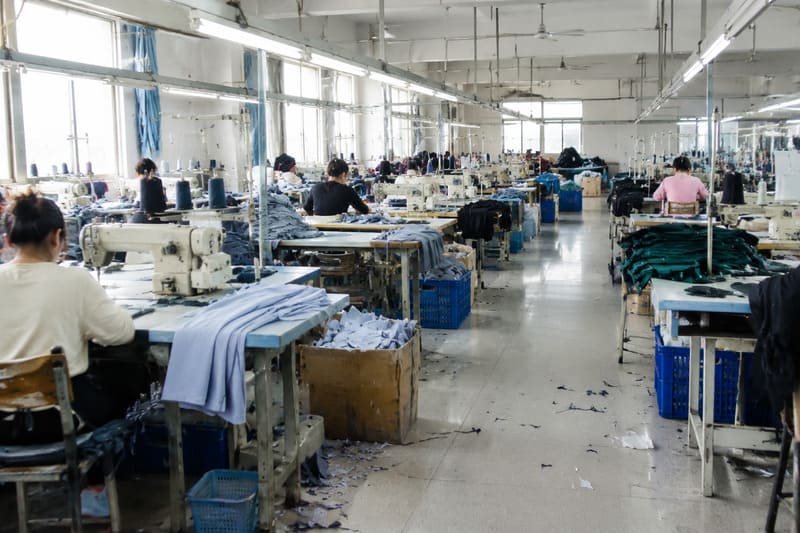
A clothing factory works through seven main steps: pattern making, cutting, decoration (like embroidery or printing), sewing, finishing, inspection, and packing. Patterns ensure size consistency, fabric is cut into panels, logos are added to those panels, sewing assembles the garment, and finishing, inspection, and packing prepare it for shipment.
That's the short answer. But each step hides details that directly affect your product quality, your lead time, and your cost. Let me walk you through the process the way I explain it to buyers who visit our facility for the first time.
What Is Pattern Making in a Clothing Factory?
Many buyers skip past pattern making because it sounds boring. That's a mistake. If the pattern is wrong, every single garment in your order will be wrong. And nobody catches it until it's too late.
Pattern making is the first step in a clothing factory. It creates the template that guarantees every garment in a batch comes out in the same size and style. Factories build patterns in one of two ways: by copying a physical sample garment 1:1, or by developing measurements from the customer's tech pack.
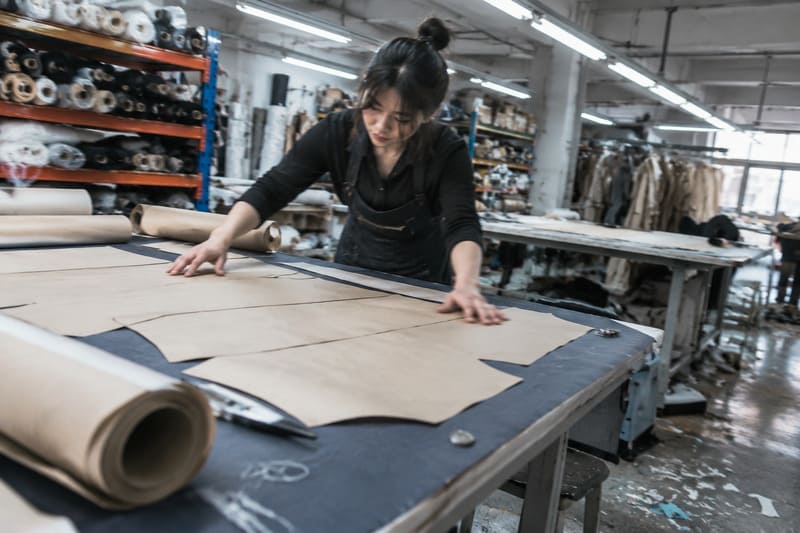
I always tell buyers this: the pattern is the DNA of your order. Everything downstream — cutting, sewing, final measurements — inherits from it.
In practice, the two starting points work like this:
- Sample-based patterning. You send us a physical garment you like. Our pattern maker measures and replicates it 1:1. This works well when you want to reproduce an existing product exactly.
- Tech pack-based patterning. You send a tech sheet with a size spec, and we translate those numbers into a working pattern. This is the standard route for brands developing something new.
Here's why this step deserves your attention as a buyer:
- Consistency at scale. A pattern error doesn't stay in the pattern room — it gets repeated across the entire production run.
- Fit approval happens here. A good factory will make a pre-production sample from the pattern and get your sign-off before cutting bulk fabric.
- It reveals communication quality. If a factory asks smart questions about your tech pack at this stage, that's a good sign. If they say "no problem, we understand" without a single question, be careful. In my experience, silence at the pattern stage usually means guessing — and guessing costs you money later.
How Does Cutting Work in a Clothing Factory?
Fabric is usually the most expensive material in a garment. Cut it wrong, and there's no undo button. That's why cutting is where cost control and precision meet inside a clothing factory.
Cutting is the second step. The factory lays fabric in layers and cuts it into panels — sleeves, front bodies, back bodies, collars — following the approved pattern. Some cutting is done by hand, and some by machine, depending on the fabric and order size. The goal is simple: turn rolls of fabric into precisely shaped pieces ready for the next steps.
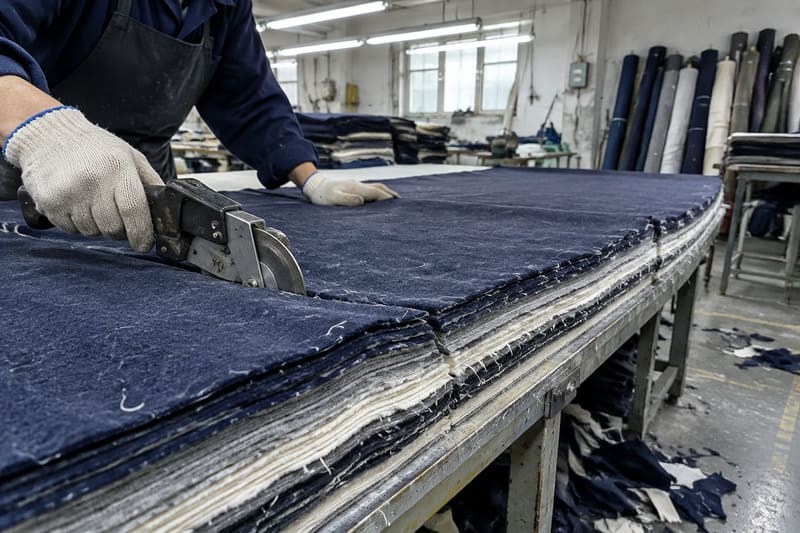
Let me expand on what actually happens on the cutting table, because a few details here matter to buyers.
First, fabric preparation comes before the blade. Quality-focused manufacturers relax or preshrink the fabric before cutting. Knit fabrics — the kind used in T-shirts, hoodies, and sweatpants — can shrink. If you cut fabric that hasn't stabilized, your garments may measure correctly at the factory and then shrink out of spec after the first wash.
Second, the choice between manual and machine cutting is practical, not fancy:
| Method | Best For | Key Benefit |
|---|---|---|
| Manual cutting | Small runs, tricky fabrics, sample making | Flexibility and careful handling |
| Machine cutting | Large volume orders | Speed, consistency across layers |
Third, cutting accuracy is a quality gate. Panels that are even slightly off-shape can create problems at sewing: puckered seams, twisted side seams, mismatched stripes. A skilled cutting team catches fabric flaws at this stage too — holes, stains, dye inconsistencies — before those defects get sewn into a finished garment.
When you evaluate a supplier, ask how they inspect fabric before cutting. The answer tells you a lot about how many defects will reach your final inspection.
Why Do Clothing Factories Decorate Cut Pieces Instead of Finished Garments?
You send a logo file. The factory says "no problem." Then the samples arrive and the embroidery on the cuff looks crooked, or the print sits in the wrong spot. Decoration is where a lot of orders quietly go wrong.
Most clothing factories add embroidery or screen printing to cut panels, not finished garments, when working on production orders. A flat panel can be spread and fixed onto an embroidery machine or printing table regardless of the logo's position. This makes the decoration result far more controllable and consistent.
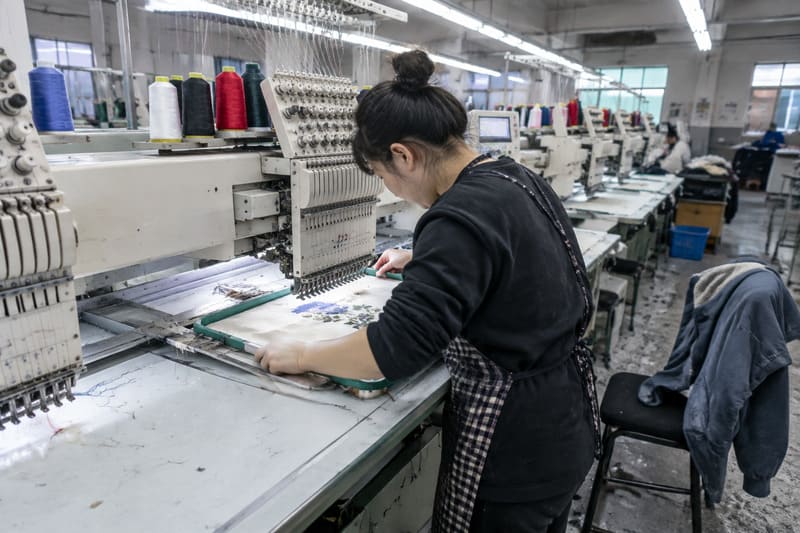
Not every order includes this step — a plain blank garment skips it entirely. But most branded orders do, so let me explain why panel decoration matters with a real example.
Say your logo doesn't go on the big empty space across the chest. Instead, you want a small embroidery tucked into a corner of the sleeve cuff. On a finished garment, that tiny corner cannot be spread flat or hooped onto an embroidery machine. There's simply no way to fix it in place. The operation becomes physically impossible, or the result comes out distorted.
A cut panel solves this completely. Before sewing, that cuff is just a flat piece of fabric. It lies flat on the machine no matter how big or small the placement area is. The logo goes on cleanly, in exactly the right position, every time.
The same logic applies to printing:
- Better registration. Flat panels hold still, so multi-color prints line up correctly.
- Consistent placement. The print position is measured from the panel edges, so piece #1 and piece #5,000 match.
- Access to difficult positions. Side seams, hoods, pocket edges — all reachable before assembly.
How Does Sewing Turn Cut Pieces Into a Finished Garment?
At this point, your order is still a pile of flat fabric pieces. Impressive-looking, but nobody can wear a pile of panels. Sewing is where the garment actually becomes a garment.
Sewing is the fourth step. Decorated (or plain) cut panels move to the sewing lines, where operators assemble them into complete garments using needle and thread. Different seam types and machines are used for different constructions, but the goal is the same: join every panel into a finished T-shirt, polo, hoodie, or pair of sweatpants.
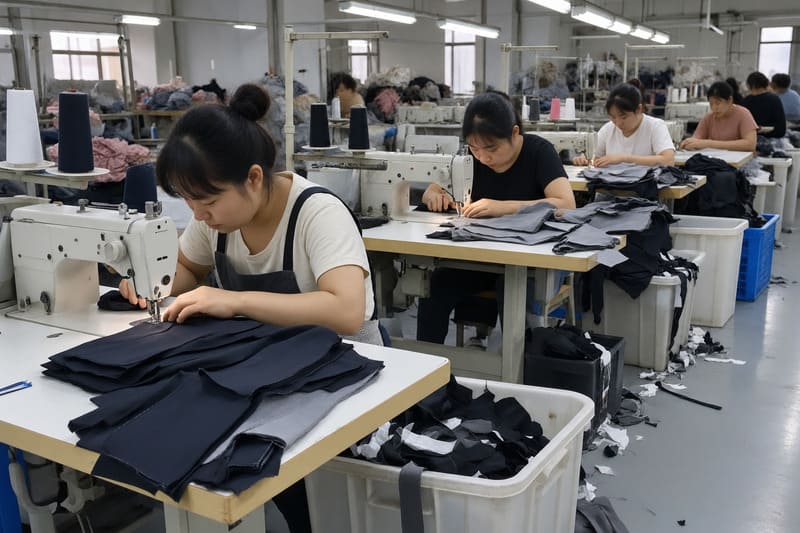
Sewing is one of the most labor-intensive stages in the whole process, and it's where a factory's real capacity lives. A few things are worth understanding as a buyer.
Sewing works as a line, not a single person. One garment passes through many hands. One operator joins shoulders, another attaches sleeves, another closes side seams, another hems the bottom. Each station uses a machine suited to that operation — overlock machines for joining knit panels, coverstitch machines for hems[^1], and so on. I won't go deep into every stitch type here; the point is that assembly is a coordinated sequence, and the line's rhythm determines output.
Line capacity determines your lead time. This is why "when will production finish?" should never get a vague answer. A properly managed factory knows its daily output per line.
In-process checks happen here too. Waiting until the end to inspect is expensive. Random inspection during sewing catches skipped stitches, tension problems, and misaligned seams while they're still cheap to fix.[^2] Ask your supplier whether they inspect during sewing or only at the end — the answer directly affects your defect rate.
What Happens During Finishing, Inspection, and Packing?
The garment is sewn. Many buyers assume the work is done. It isn't — and the last three steps are exactly where "almost good" orders either become shippable products or become claims.
After sewing, garments go through finishing (ironing, trimming loose threads, attaching accessories), then inspection (checking measurements, fabric flaws, stitching, and logo placement), and finally packing (folding, bagging, tagging, and boxing according to the customer's requirements). Only then is the order ready to ship.
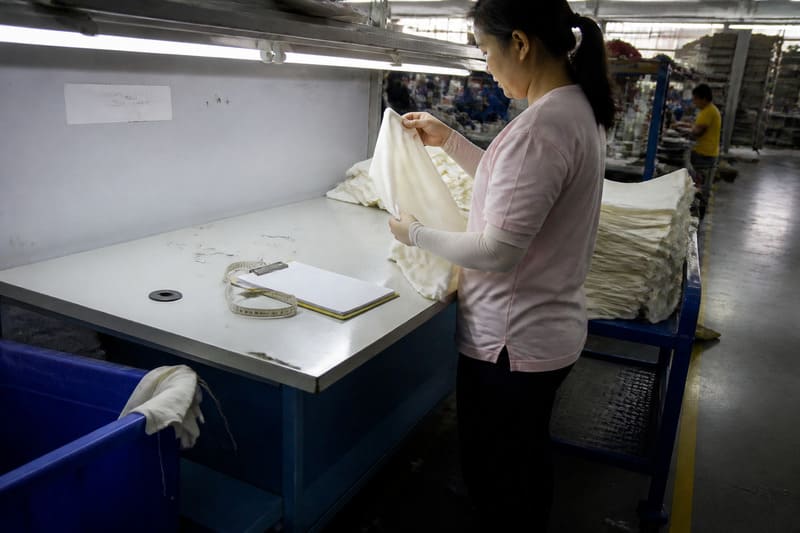
Let me break these three steps down, because each one has a job.
Finishing: making the garment presentable
Fresh off the sewing line, a garment looks rough. Finishing fixes that:
- Ironing/pressing removes wrinkles and sets the garment's shape.
- Thread trimming removes loose ends left by sewing operations.
- Adding accessories — drawcords, hang loops, extra trims — happens here if required.
Inspection: checking whether the garment is actually correct
Once finishing is complete, the garment moves to inspection.
This is where the factory checks whether the finished product matches what was approved before production. The inspection normally covers several basic points:
- Measurements. Does the finished garment match the approved size specifications?
- Fabric. Are there stains, holes, color differences, or other visible defects?
- Sewing. Are there skipped stitches, open seams, or other workmanship problems?
- Decoration. Is the logo the correct size, and is it positioned where it should be?
This step sounds straightforward, but it matters because a garment can look fine at first glance and still be wrong. A T-shirt may be beautifully sewn but 2 cm too short. An embroidered logo may look perfect but sit too high on the chest. Inspection is the last opportunity to catch those problems before the garments are packed.
Packing: preparing the order for shipment
Once the garments pass inspection, the final step is packing.
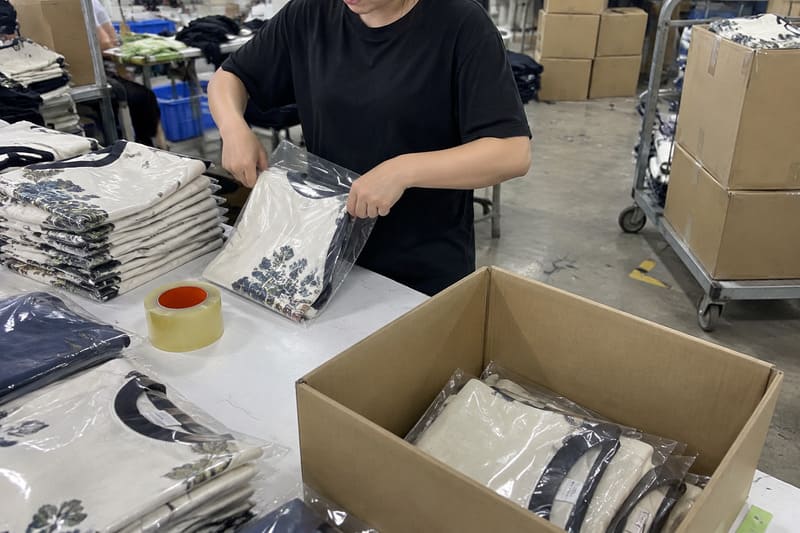
The exact packing method depends on the buyer's requirements. Garments are normally folded, tagged, placed into bags, and then packed into cartons for shipment.
There can be many details involved — which hangtag to use, what type of polybag is required, how many pieces go into each carton, and so on. I won't go too deep into those details here because the basic principle is simple: the factory packs the finished garments according to the customer's packing requirements and prepares them for shipment.
At this point, the seven-step production process is complete:
Pattern making → Cutting → Decoration → Sewing → Finishing → Inspection → Packing
But understanding these seven steps also reveals something important about how clothing factories actually work.
Does a Clothing Factory Really Make Everything In-House?
There's a common image people have of a "factory": you walk through the gate, and everything needed to make the product happens inside that one building.
That's usually not how clothing manufacturing works.
Look back at the seven steps above. A clothing order involves much more than sewing machines. You need fabric, trims, labels, embroidery or printing, hangtags, polybags, cartons, and sometimes other specialized materials or processes.
Most clothing factories don't manufacture all of these things themselves.[^3]
For example:
- Fabric may come from a fabric supplier.
- Embroidery may be sent to an embroidery factory.
- Printing may be handled by a printing factory.
- Labels, buttons, zippers, drawcords, and other trims come from different accessory suppliers.
- Polybags, cartons, and other packing materials come from packaging suppliers.
Large manufacturers may own some of these facilities themselves. A big factory group might have its own fabric mill, embroidery department, or printing facility.[^4] But for most clothing factories, at least some of these materials and processes come from outside suppliers.
So when you place an order with a clothing factory, you're often not dealing with one isolated factory. You're dealing with the center of a small supply chain.
This is also why supplier management matters so much.
Once you see it this way, a clothing factory becomes much less mysterious.
Final Thoughts
So, how does a clothing factory work?
At the production level, the process is quite straightforward: make the pattern, cut the fabric, add decoration when required, sew the panels together, finish the garment, inspect it, and pack it for shipment.
But behind those seven steps is a network of fabric mills, trim suppliers, embroidery shops, printing facilities, and packaging suppliers that may all contribute to one order.
The clothing factory sits in the middle of that process. Its real job is to bring all those materials and processes together and turn them into thousands of consistent finished garments.
That's why, when you're evaluating a clothing factory, don't only look at the sewing machines on the production floor. Look at how well the factory manages the entire process. In the end, that's what determines whether the right product arrives at the right quality and at the right time.
[^1]: "Selecting an Overlock Sewing Machine - Publications", https://pubs.nmsu.edu/_c/C218/index.html. Apparel technology references and ISO 4915 stitch type classifications document the functional roles of overlock and coverstitch machines in garment construction, with overlock stitches used for edge finishing and seaming stretch fabrics and coverstitch configurations applied to hems requiring elasticity. Evidence role: definition; source type: education. Supports: That overlock (serger) machines are the standard equipment for seaming knit fabric panels and that coverstitch machines are conventionally used for hemming operations in apparel production. Scope note: Machine selection in practice depends on fabric type, seam specification, and factory equipment; the cited roles represent common applications rather than exclusive uses.
[^2]: "End-of-line vs. in-process inspection: which prevents more ...", https://www.skillreal.com/content/end-of-line-vs-in-process-inspection-which-prevents-more-defects. Quality management literature, including work derived from the 'cost of quality' framework, consistently demonstrates that the cost of correcting a defect rises as it progresses through production stages, providing the theoretical basis for in-process inspection practices in apparel and other manufacturing sectors. Evidence role: expert_consensus; source type: research. Supports: That detecting and correcting defects during production is less costly than detection at final inspection, because rework costs increase as defective work-in-progress advances through subsequent production stages. Scope note: Quantitative cost ratios vary by product type, defect category, and factory context; the principle is well-established but specific figures cited in general sources may not reflect apparel manufacturing conditions directly.
[^3]: "Fashion's Supply Chain Challenge", https://unfccc.int/sites/default/files/resource/Fashion%20supply%20chain%20challenge_white%20paper%202025.pdf. Supply chain research on the global apparel industry documents a predominantly fragmented production structure in which cut-and-sew factories source fabric, accessories, and specialist services such as embroidery and printing from separate upstream suppliers, with full vertical integration confined largely to large manufacturer groups. Evidence role: general_support; source type: research. Supports: That garment factories typically operate within fragmented supply chains, sourcing fabric, trims, and specialist processes from external suppliers rather than being fully vertically integrated. Scope note: The degree of vertical integration varies significantly by factory scale, country, and product category; the claim reflects a general industry tendency rather than a universal condition.
[^4]: "Vertically Integrated Manufacturing Process - Gildan", https://gildancorp.com/en/company/manufacturing-process/vertical-integration/. Research on apparel industry structure documents that vertically integrated manufacturer groups, particularly in major export countries, have developed in-house fabric milling, dyeing, and finishing capabilities alongside cut-and-sew operations, enabling tighter supply chain control and shorter lead times compared to non-integrated competitors. Evidence role: historical_context; source type: research. Supports: That some large apparel manufacturing groups pursue vertical integration by owning upstream fabric production and downstream decoration or finishing facilities, reducing dependence on external suppliers. Scope note: The extent of vertical integration varies considerably by country, product category, and company scale; sources describe the phenomenon without establishing it as the dominant model in the industry.
[^5]: "Careers in Global Fashion Supply Chain Management", https://www.limcollege.edu/careers-internships/career-pathways/careers-global-fashion-supply-chain-management. Supply chain management research on the global apparel industry characterizes cut-and-sew factories as focal firms within multi-tier supplier networks, responsible for coordinating upstream material flows and downstream delivery commitments in addition to their direct manufacturing operations. Evidence role: general_support; source type: research. Supports: That garment factories in global supply chains perform a coordination role extending beyond physical assembly to include materials procurement, subcontractor management, production scheduling, and quality oversight. Scope note: The degree of coordination responsibility varies by factory type, buyer-supplier relationship structure, and whether the factory operates on a full-package or cut-make-trim basis.