Finding a factory to make your clothes sounds simple enough — just Google it, right? But here's the thing. The real challenge isn't locating factories. It's finding one that actually gets you. One that thinks from your perspective, anticipates your problems, and guides you through the process instead of just throwing questions at you.
The single most important thing when searching for a clothing manufacturer is finding a factory with a "buyer's mindset" — one that stands in your shoes and thinks about your project from your angle. A factory like this will solve roughly 90% of your procurement headaches. They become a project partner, not just an order-taker, and that distinction makes all the difference between a smooth launch and a costly disaster.
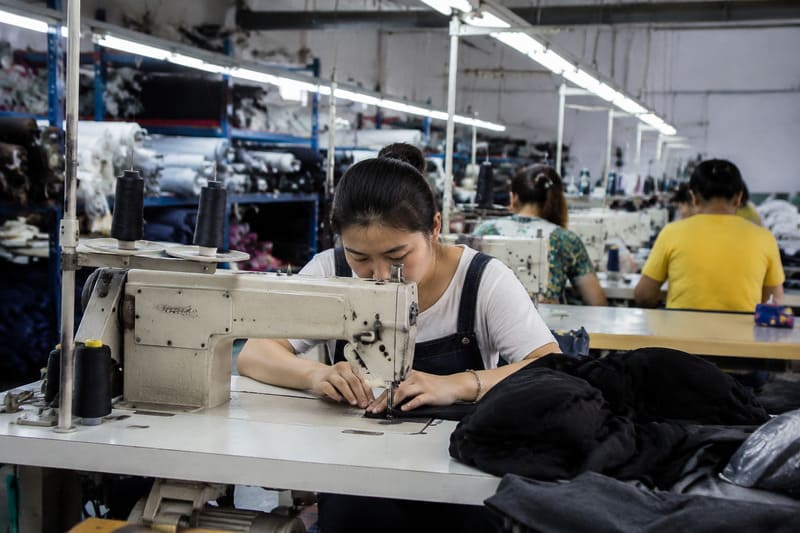
Look, I've been in the garment manufacturing business for nearly two decades now. And I can tell you — the "finding" part is genuinely easy. The "choosing the right one" part? That's where most brands get it wrong. Let me walk you through everything I've learned, so you don't have to learn it the hard way.
Where Can You Actually Find Clothing Factories?
Let's get the easy part out of the way first. If we're talking purely about finding factories — like, literally discovering they exist — there's honestly no technical difficulty here at all.
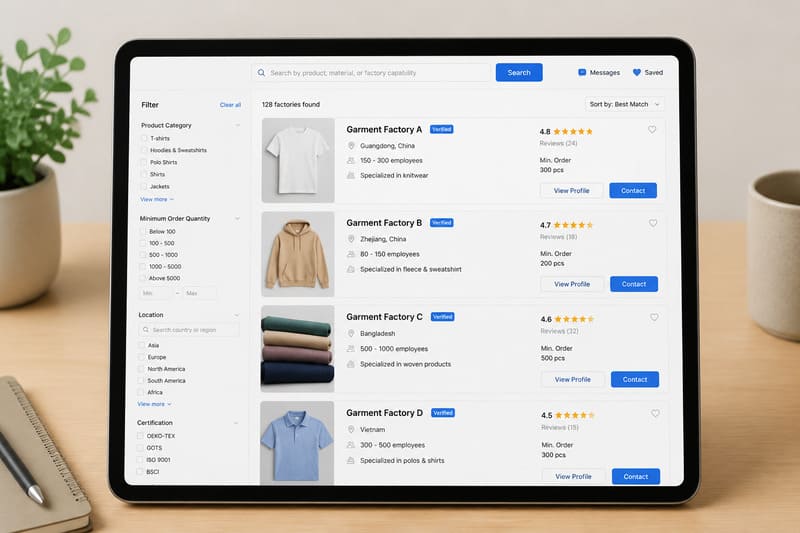
You can find thousands of clothing manufacturers within minutes using online marketplaces and search engines. Platforms like Alibaba, Made-in-China, Global Sources, and regional marketplaces from India, Pakistan, Bangladesh, and beyond list tens of thousands of garment factories ready to take your order.
The Most Common Channels
Here's a quick breakdown of where buyers typically start their search:
| Channel | Examples | Pros | Cons |
|---|---|---|---|
| B2B Marketplaces | Alibaba, Made-in-China, IndiaMART | Huge selection, easy to browse | Overwhelming volume, hard to differentiate |
| Search Engines | Google, Bing | Can find niche factories with specific capabilities | Requires good keyword skills |
| Trade Shows | Canton Fair, MAGIC, Texworld | Face-to-face meetings, see samples in person | Expensive, time-consuming |
| Referrals | Industry contacts, LinkedIn | Pre-vetted, trusted recommendations | Limited pool |
| Sourcing Agents | Independent agents, sourcing companies | Local expertise, factory audits | Additional cost layer |
All of these work. Seriously, any of them will get you a list of factories. But here's the honest truth — getting that list is like step one of a hundred-step journey. The moment you open Alibaba and type "custom t-shirt manufacturer," you're going to feel like you just jumped into a factory ocean. Thousands of suppliers, all making similar products, all offering what sounds like the exact same clothing manufacturing service.
The Real Problem Isn't Finding — It's Filtering
And when you start reaching out? Oh boy. Every single one of them will tell you some version of the same thing:
"Our factory is very big. Our quality is very good. Our price is very competitive."
Sound familiar? Yeah, I thought so.
You won't feel much of anything reading those replies. And there's a very specific reason for that — every word they're saying is about them. "We factory this, we factory that." It's never about you. So naturally, you don't really care. Why would you? They haven't given you a reason to.
The difficulty isn't finding a factory to make your clothes. It's identifying which one out of those thousands will actually be the right partner for your brand. And that, my friend, requires understanding what separates a mediocre supplier from a great one.
What Does a Factory With "Buyer's Mindset" Look Like?
Most factories operate with what I call "seller's mindset." They ask questions purely from their own production perspective. And honestly? It's kind of painful to watch from the buyer's side.
A factory with a "buyer's mindset" is one that prioritizes understanding your project goals, your current stage, and your constraints before jumping into production details. Instead of interrogating you with technical specs, they guide you through options, explain trade-offs, and help you make informed decisions — essentially acting as a project consultant rather than a passive order executor.

The Seller's Mindset Problem — A Real Example
Let me give you a very specific example so you can really feel what I'm talking about.
Say you've shortlisted 5 to 10 factories from Alibaba and sent out your initial inquiry. There's a very high probability — like, annoyingly high — that you'll get responses like this:
- "What's your quantity?"
- "How many colors do you need?"
- "How many sizes?"
- "What size buttons do you want — in millimeters?"
- "What dimensions should the embroidery be?"
Now, are these valid questions? Absolutely. A factory genuinely needs this data to calculate pricing and assess whether they can take the order. I'm not saying the questions themselves are wrong.
But notice something — every single question is asked from the factory's perspective. They need this information for their process. This is classic seller's mindset. The factory is essentially saying, "Give me everything I need so I can decide if this order is worth my time."
Why This Approach Fails You
Here's the thing they completely miss. When you send that first inquiry, there's a very good chance your project just got approved internally. Maybe you're still in the discussion phase. You might not even know what button size you want — and frankly, why would you? That's why you're reaching out to a manufacturer in the first place!
So when you're sitting there, still figuring out your project scope, and some factory immediately hits you with "what millimeter buttons do you need?" — well, do you really think that factory is going to care about your success down the road? If they can't even read the room on email number one, imagine what happens when things get complicated during production.
What Buyer's Mindset Actually Looks Like
A factory with genuine buyer's mindset operates completely differently. Here's what happens when you work with one:
-
They ask about your project first — What's the end goal? Who's the target customer? What stage are you at right now? Is this a new product launch or a reorder?
-
They meet you where you are — If you're in the early concept phase, they don't bombard you with production specs. They offer guidance, share industry knowledge, and help you shape the product concept into something manufacturable.
-
They present options, not ultimatums — Instead of asking you to decide everything, they'll say something like: "For this type of hoodie, you have three fabric options. Option A gives you better drape but costs more. Option B is the industry standard — good balance. Option C saves cost but the hand-feel is noticeably different. Here's a comparison table."
-
They communicate proactively at every step — They tell you what's coming next, what decisions you'll need to make, and when. No surprises. No hidden problems that surface at the shipping stage.
-
They flag risks before they become problems — "If we go with this embroidery placement, there's a risk of puckering on this fabric weight. Here's what we recommend instead."
See the difference? This kind of factory becomes a participant and advisor in your project. Not just an executor waiting to be told what to do. Everything they do starts from your interest and ends with solving your problem.
Is It Easy to Find a Factory With Buyer's Mindset?
I'm going to be honest with you here, and my answer might be a little disappointing. Short answer: no, it's really not easy.
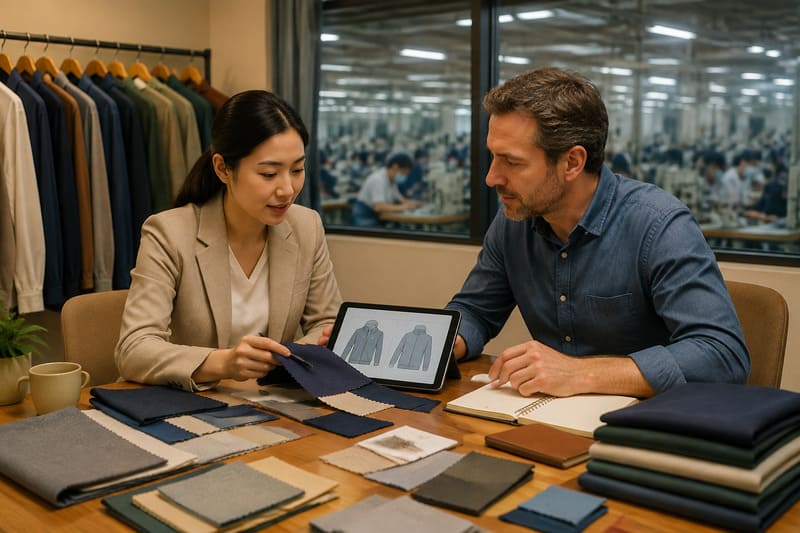
Based on my 20+ years in garment manufacturing, factories with genuine buyer's mindset are extremely rare — in my experience, most factories don't operate this way. Very few have this kind of thinking built into their DNA. It's not that they're bad factories. It's that most manufacturers are production-focused, not relationship-focused.
Why Is Buyer's Mindset So Rare?
There are a few structural reasons:
-
Production culture dominates — Most garment factories are built around machines, output, and efficiency. Their staff thinks in terms of cuts-per-hour and stitches-per-minute. Customer communication is often an afterthought, not a core competency.
-
Sales teams lack project experience — Many factory salespeople are trained to quote prices and close deals. They're not trained to manage complex procurement projects or to think strategically about a buyer's business needs.
-
Volume over value — In a low-margin industry, many factories prioritize getting as many orders as possible. Spending time to deeply understand one buyer's project doesn't fit their business model.
-
Language and cultural barriers — Even when the intent is there, communicating nuanced project guidance across languages and time zones is genuinely difficult. It requires a level of English fluency and cross-cultural business understanding that most factory sales staff simply haven't developed.
What Happens When You DO Find One
But here's the flip side — and this is the encouraging part. If you manage to find a factory that thinks this way during your search? Congratulations. Seriously. Your procurement process will become dramatically smoother. Your brand gets a strong, reliable supply chain backbone that you can build on for years.
What Are the Common Mistakes When Searching for a Clothing Factory?
Beyond the buyer's mindset issue, there are several traps I see brands fall into over and over again when they try to find a factory to make their clothes. Let me save you from the most common ones.
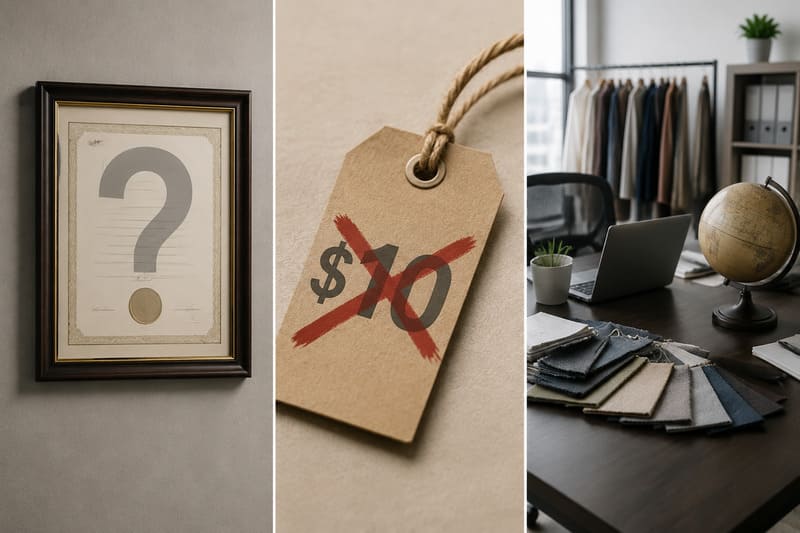
Even experienced procurement managers sometimes make avoidable errors during supplier selection. The three biggest mistakes are over-trusting certifications, chasing the lowest price, and automatically dismissing trading companies. Any one of these can cost you time, money, or both.
Mistake #1: Blindly Trusting Certifications
Look, I'm not saying certifications don't matter at all. They do provide some signal. But here's what most buyers don't realize — in my experience, obtaining a certification often comes down to paying for and preparing for the audit process. Pass the audit (which is often quite manageable with some preparation), and you've got a shiny certificate to display on your page.
The correlation between having impressive certificates and actually delivering good results? It exists, but it's weaker than you'd think.
I've seen plenty of factories with walls covered in certifications that:
- Respond to emails painfully slowly
- Miss delivery deadlines regularly
- Ship goods with obvious quality issues
So what should you do instead? Treat certifications as one sign that a company is legitimate—nothing more. Pay attention to how they communicate during the inquiry phase — that tells you far more about what working with them will actually be like.
Mistake #2: Choosing Based on Price Alone
This one is huge. When one factory's quote comes in significantly lower than everyone else's — and I mean noticeably lower, not just a few cents — that should actually trigger alarm bells, not celebration.
Here's what I recommend:
- Always request samples first — Before placing any order, get physical samples and evaluate them carefully.
- Demand a pre-production sample after order placement — This confirms they can replicate the approved sample at scale.
- Require a final bulk production sample — Compare it against both previous samples. All three should be consistent in quality.
- Never skip third-party inspection[^1] — This is non-negotiable. Independent inspection protects you from the classic bait-and-switch: beautiful sample, terrible bulk goods.
The cheapest quote is only cheap if you actually receive what you ordered. If you end up with quality issues, the "savings" evaporate instantly — and you lose a lot more in returns, brand damage, and wasted time.
Mistake #3: Only Looking at Factories and Ignoring Trading Companies
Now, this might sound funny coming from me — Garmentown is a factory, after all. But I genuinely believe this advice is worth giving.
Here's the reality: factories are often hyper-specialized. Because of their machinery setup, they can typically only produce certain types of products efficiently. And most factories don't produce all their raw materials and accessories in-house. They purchase fabrics, trims, buttons, zippers, and packaging from external suppliers[^2]. Sound familiar? That's essentially the same model as a trading company.
In fact, some experienced trading companies:
- Buy raw materials in larger bulk quantities across multiple factory orders, giving them better unit costs
- Have broader product knowledge because they work with diverse factory types
- Offer more flexible sourcing for complex or multi-category orders
So yeah — sometimes a good trading company can actually offer better prices than a factory. That's not weird or suspicious. It's just how supply chain economics work.
The takeaway: Don't automatically dismiss a supplier just because they're a trading company. Evaluate them on the same criteria you'd use for a factory — communication quality, sample quality, transparency, and reliability.
How Should You Evaluate a Factory Before Placing Your First Order?
So you've found some promising factories. You've filtered out the obvious mismatches. Now what? How do you actually evaluate whether a clothing factory deserves your business?
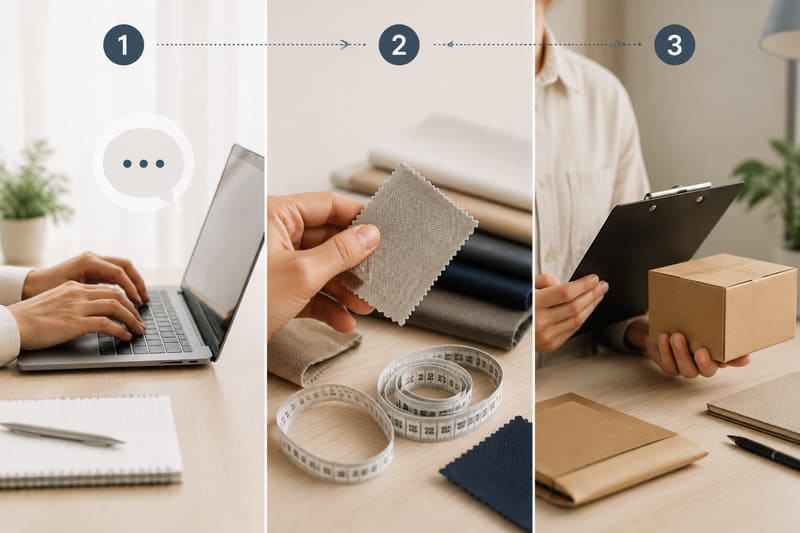
The best way to evaluate a potential clothing manufacturer is through a structured trial process: start with communication quality, then move to sample evaluation, and finally assess their transparency and project management capabilities during a small trial order before committing to large volumes.
Step 1: Evaluate Communication Quality
This is honestly the most underrated evaluation criterion. Before you even talk about price or capacity, pay attention to how the factory communicates:
- Do they answer your actual question? Or do they give generic replies that don't address what you asked?
- How fast do they respond? Consistent delays during the inquiry phase are a red flag.
- Do they ask smart questions about your project? Or do they just fire off a list of specs they need?
- Are they transparent? Do they proactively share information, or do you have to pull every detail out of them?
Step 2: Sample Evaluation
Request samples — both existing stock samples and custom samples based on your specifications. Evaluate:
- Fabric hand-feel and weight — Does it match what was promised?
- Construction quality — Check stitching, seams, hems, and finishing
- Decoration accuracy — Embroidery, printing, or heat press quality
- Sizing consistency — Measure against your tech pack specs
- Wash testing — Always wash samples to check for shrinkage, color bleeding, and durability[^3]
Step 3: Trial Order
If samples pass, place a small trial order. During production, evaluate:
| Evaluation Area | What to Watch For |
|---|---|
| Timeline accuracy | Did they deliver when they said they would? |
| Proactive updates | Did they keep you informed without you asking? |
| Problem handling | When issues arose, did they tell you immediately or try to hide it? |
| Final quality | Does the bulk match the approved sample? |
| Documentation | Did they provide pictures or videos when goods ready, shipping documents, etc.? |
A factory that performs well across all three steps — communication, samples, and trial order — is one worth building a long-term relationship with.
Frequently Asked Questions
How many factories should I contact before choosing one?
I'd recommend reaching out to at least 8-10 factories initially. After initial responses, narrow down to 3-5 based on communication quality and relevance. Request samples from your top 2-3 choices. This gives you enough comparison data without making the process unmanageable.
Should I always choose a factory over a trading company?
Not necessarily. A factory gives you direct access to production, but a good trading company can offer competitive pricing, broader sourcing capability, and sometimes better project management. Evaluate based on communication, quality, and reliability — not just the business model label.
How long does it typically take to find a reliable clothing factory?
From the first inquiry to a confirmed supplier, allow roughly 4–12 weeks for a straightforward product. That usually includes initial communication, quotation, sampling, revisions, and a small trial order. A more technical garment, new fabric development, or extensive decoration can take longer. Rushing this stage is usually more expensive than spending a few extra weeks validating the right supplier.
[^1]: "Textile and Apparel Inspection", https://www.intertek.com/textiles-apparel/inspection/. Major inspection service providers and trade advisory bodies such as the International Trade Centre recommend pre-shipment third-party inspection as a standard risk mitigation practice for apparel importers, noting that quality deviations between samples and bulk production are common in garment manufacturing due to variations in materials, operator skill, and production conditions. Evidence role: expert_consensus; source type: institution. Supports: That third-party quality inspection is a widely recommended best practice for apparel importers to verify bulk production quality against approved standards. Scope note: Defect rates and the prevalence of sample-to-bulk discrepancies vary by factory, product type, and region, and comprehensive industry-wide statistics are limited. [^2]: "Exploring supply chain capabilities in textile-to- ...", https://www.sciencedirect.com/science/article/pii/S2772390924000143. The global apparel supply chain is characterized by extensive fragmentation and specialization, with the majority of garment factories operating as cut-make-trim (CMT) or cut-make-pack (CMP) facilities that procure fabrics, trims, and packaging components from upstream suppliers. Evidence role: mechanism; source type: paper. Supports: That most garment manufacturers are cut-make-trim (CMT) operations that source fabrics, trims, and accessories from external suppliers rather than producing them in-house. Scope note: The degree of vertical integration varies by region and factory scale; some large manufacturers in countries like China and Turkey maintain partially integrated operations. [^3]: "Domestic washing and drying procedures for textile testing", https://www.iso.org/standard/43044.html. Textile testing organizations such as AATCC (American Association of Textile Chemists and Colorists) and ISO have established standardized wash test methods—including AATCC TM 135 for dimensional change and ISO 105-C06 for colorfastness to washing—that are widely adopted in the apparel industry to evaluate garment performance prior to bulk production approval. Evidence role: definition; source type: institution. Supports: That wash testing is a standard quality assurance procedure in the apparel industry, governed by established testing standards for evaluating dimensional stability, colorfastness, and fabric durability. Scope note: Specific test methods and acceptable tolerance thresholds vary by product type, target market, and buyer specifications.