The difference between a jersey and a T-shirt sounds like a simple question, but it trips up a lot of buyers. I have seen tech sheets that say "jersey shirt" and mean three different things. That confusion costs time, sampling rounds, and sometimes money. So let me clear it up the way I explain it to my own customers.
The word "jersey" has two meanings. It can mean a knit fabric construction, or it can mean a sports shirt. A T-shirt is a garment category. If "jersey" means the fabric, then jersey is one of the most common knit structures used to make T-shirts. If "jersey" means sportswear, then the difference is mainly purpose, fiber, fabric type, and decoration method.
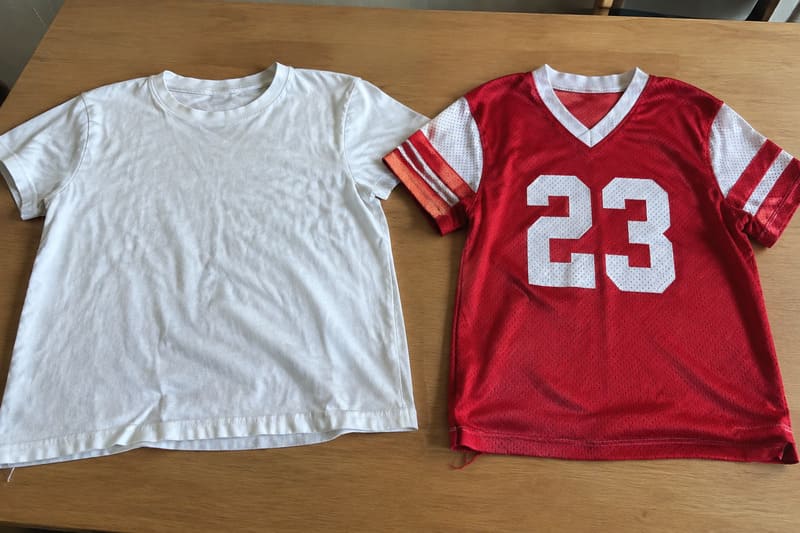
That is the short version. But the short version will not help you write a clear purchase order. Below, I break down both meanings of "jersey," show you what each one looks like, and then explain exactly what to say to a factory so nobody has to guess.
Why Does the Word "Jersey" Cause So Much Confusion?
A request that says, "We need 5,000 jersey shirts," can mean two very different products: a cotton tee or a polyester soccer shirt. Same word, two completely different products.
The confusion comes from history. The word "jersey" was first used for a type of knitted cloth associated with the island of Jersey. By the 19th century, it was also being used for close-fitting knitted garments worn in sports.[^1] Today both meanings live side by side, and neither one is wrong.
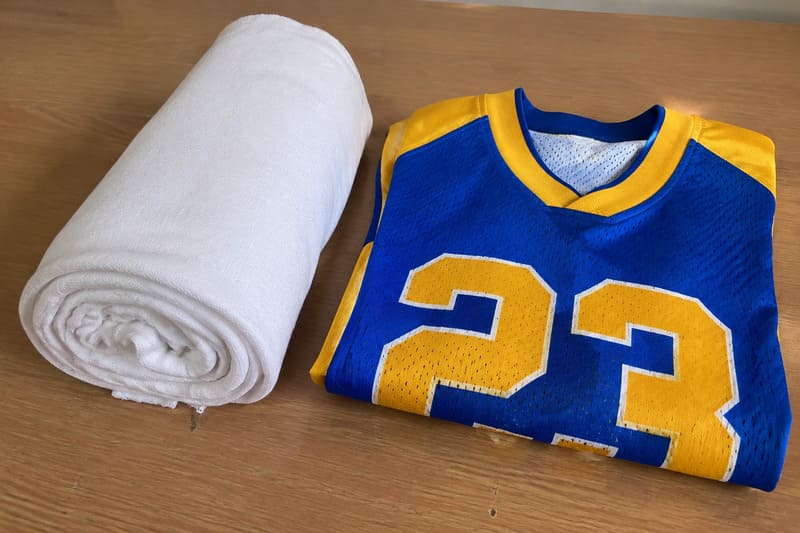
Meaning one: jersey as a fabric construction
In textile terms, jersey is a weft-knit structure. It describes how the yarn loops are formed, not what the yarn itself is made of.[^2] You can have cotton jersey, polyester jersey, or viscose jersey. The word describes the knit, not the fiber.
Meaning two: jersey as a sports shirt
In everyday speech, especially in North America, Europe, and Oceania, "jersey" often means the shirt a team wears. A soccer jersey. A basketball jersey. A hockey jersey. In this sense, the word describes a finished garment with a specific use.
Why this matters for buyers
When you send an inquiry, the factory reads the specifications you provide. If you write only "jersey," the merchandiser still has to determine which meaning you intend. A good supplier should confirm it, but unclear terminology creates unnecessary back-and-forth and increases the risk of quoting or sampling the wrong product.
I keep a simple rule for my team: never quote a "jersey" without confirming the meaning first. It takes one extra email. It can save a wasted sample.
So before we compare anything, we need to split the question in two. I will handle the fabric meaning first, then the sportswear meaning.
What Is the Difference Between Jersey Fabric and a T-Shirt?
They are not the same type of thing. One is a fabric construction. The other is a finished garment.
A T-shirt is a garment category. Jersey fabric is a knit construction used to make garments. Most T-shirts are made from single jersey, but jersey fabric is also used for polos, henleys, base layers, casual long sleeves, and athletic tops. So the relationship is not really "jersey vs T-shirt." It is "jersey is what many T-shirts are made of."
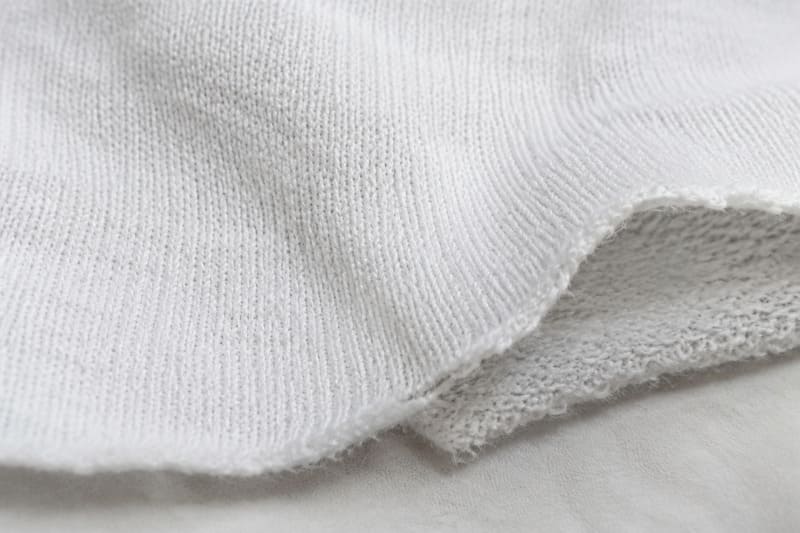
What does single jersey look like?
The most common jersey construction is single jersey. You can spot it easily once you know the signs:
- Face side: vertical columns of fine V-shaped loops
- Back side: the loop crowns are more visible, giving the reverse a different texture[^2]
- Edges: cut edges naturally tend to curl because of the asymmetric knit structure[^3]
This structure gives jersey its personality. The fabric is soft, drapes well, and moves with the body. Because knitted yarns form interconnected loops, the fabric also has natural extensibility even without elastane.[^2] That is one reason single jersey works so well for T-shirts.
Which fibers are used in jersey?
Because jersey describes the knit, not the fiber, you will see many versions on the market:
| Fiber | Typical feel | Common use |
|---|---|---|
| Cotton jersey | Soft, breathable, matte | Everyday tees, basics |
| Poly/cotton blend jersey | Softer hand, less shrinkage | Promo tees, uniforms |
| Polyester jersey | Smooth, quick-dry | Athletic tops, sublimation |
| Viscose jersey | Fluid, silky drape | Fashion tees, women's wear |
| Modal jersey | Very soft, holds color | Premium basics |
Any of these can also contain a small percentage of elastane, often around 3% to 10% depending on the end use, to improve stretch recovery and shape retention.[^4] So when a customer says "cotton jersey," I still ask about the exact blend percentage and weight.
Where else is jersey used?
Jersey is not limited to T-shirts.
- T-shirts — single jersey is one of the most common constructions; roughly 140–220 GSM is common for many everyday styles, while heavyweight fashion styles can go higher
- Polo shirts — jersey or pique, depending on the style
- Hoodies — some lightweight constructions have a jersey face, while heavier versions commonly use fleece or French terry
- Sweatpants — lightweight jersey can be used for certain summer or casual styles
So if someone asks me "which is better, jersey or a T-shirt," I answer with another question: "Do you mean the fabric or the finished shirt?" Because a T-shirt is very often made from jersey.
What Is the Difference Between a Sports Jersey and a Regular T-Shirt?
Now let us take the second meaning. Here, "jersey" means the team shirt. In this case, comparing a jersey and a T-shirt makes sense because both are finished garments, but they are usually built for different jobs.
A sports jersey is designed for athletic use. It is commonly made from polyester performance knit or mesh, with fabric construction and finishing chosen for moisture management and movement. A regular T-shirt is usually designed for everyday wear and is commonly made from cotton or a cotton blend in single jersey.
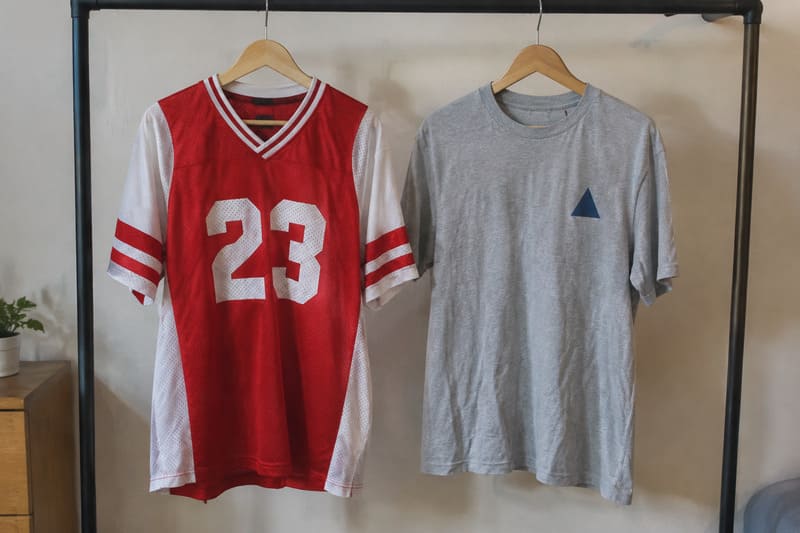
Side-by-side comparison
| Feature | Sports Jersey | Regular T-Shirt |
|---|---|---|
| Main purpose | Sports / teamwear | Everyday wear |
| Common fiber | Polyester | Cotton / cotton blends |
| Fabric | Performance knit / mesh | Usually single jersey |
| Moisture management | Usually important | Usually secondary |
| Decoration | Sublimation / heat transfer / screen print | Screen print / DTF / DTG |
| Fit | Sport-specific / athletic | Regular / slim / oversized |
Why the fiber choice is different
Polyester absorbs very little moisture into the fiber itself compared with cotton and generally dries faster. But that does not mean every polyester fabric automatically wicks sweat well. Actual moisture-management performance also depends on the yarn, knit construction, fabric structure, and finishing treatment.[^5]
That is why polyester and polyester-rich fabrics are widely used in performance jerseys: the material and fabric construction can be engineered around lightweight performance, drying speed, and moisture transport.
Cotton, on the other hand, absorbs more moisture and is commonly chosen for everyday T-shirts because of its familiar hand feel and comfort. The better choice depends on what the garment is supposed to do.
Why the decoration method is different
Standard dye-sublimation printing is intended for polyester or polyester-coated substrates and works best on white or light-colored polyester fabrics. Untreated 100% cotton is not suitable for normal garment sublimation because the sublimation dye does not bond to cotton in the same way it bonds to polyester.[^6]
That makes sublimation particularly useful for polyester sports jerseys with full-color or all-over designs.
Regular T-shirts offer more decoration options. Screen printing pushes ink through a stencil onto the garment. DTG uses a printer to jet textile ink directly onto the garment, while DTF first prints the design onto a film and then transfers it to the fabric using adhesive and heat.[^7]
Which method works best depends on the fiber content, garment color, design, order quantity, and required finish.
Why the fit is different
Sports jersey fit is determined by the movement and requirements of the sport. Depending on the application, the body may be loose or tapered, and the sleeves, shoulders, and armholes may be adjusted for movement or equipment.
A regular T-shirt is influenced more by fashion and everyday fit preferences. Slim, regular, boxy, oversized — the cut changes with the style and market.
A quick mistake I still see
A customer once asked for "cotton sports jerseys with sublimation printing." For standard garment sublimation, that specification is a mismatch.
We explained the issue before sampling, and they switched to a poly/cotton blend with heat transfer instead. If we had moved directly into sampling without checking the whole specification, the printing method would not have matched the fabric.
How Should You Describe a Jersey and a T-Shirt When Ordering From a Factory?
The final step is making sure your supplier knows exactly which product you mean. Clear specifications reduce unnecessary back-and-forth and make it much easier for the factory to prepare an accurate quotation and sample.
Never write only "I need a jersey shirt." Instead, say clearly whether you need a sports jersey or a regular T-shirt. Then add the details that define the product: fiber composition, fabric construction, GSM, printing method, and quantity.
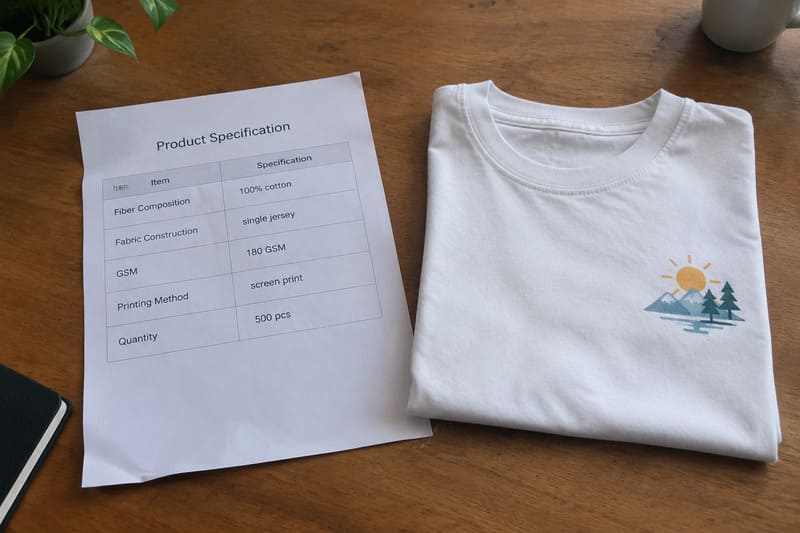
The five details that remove guesswork
Here is the checklist I ask every new customer to complete. It is short on purpose.
- Fiber composition — for example, 100% cotton, 60/40 cotton/poly, or 100% polyester. Percentages matter for hand feel, shrinkage, performance, and decoration options.
- Fabric construction — single jersey, interlock, pique, mesh, or fleece. This is where the word "jersey" belongs.
- GSM (grams per square meter) — GSM describes the mass of fabric per unit area and is the standard way factories specify fabric weight.[^8] For a typical T-shirt, 140 GSM feels relatively light, while 180–200 GSM feels more substantial. Give a number instead of relying only on words such as "light" or "heavy."
- Printing method — screen print, DTF, DTG, heat transfer, or sublimation. The method needs to match the fabric, design, and end use.
- Quantity — tell the factory how many pieces you need. Quantity affects the production method, setup cost, and final unit price.
For example, instead of writing:
"I need 500 jersey shirts."
Write something like:
"I need 500 regular T-shirts, 100% cotton single jersey, 180 GSM, with a one-color screen print on the chest."
Or, if you mean sportswear:
"I need 500 sports jerseys, 100% polyester performance knit, 150 GSM, with full sublimation printing."
Those two descriptions leave very little room for misunderstanding.
Conclusion
So, what is the difference between a jersey and a T-shirt?
It depends on what jersey means.
If jersey refers to a fabric construction, then there is no real "jersey vs T-shirt" comparison. A T-shirt is a garment, while jersey is one of the most common knit structures used to make it.
If jersey refers to a sports jersey, then the difference is mainly in purpose, fabric, fiber, decoration method, and fit.
When ordering from a factory, avoid using "jersey shirt" by itself. Say sports jersey or regular T-shirt, and then specify the fiber composition, fabric construction, GSM, printing method, and quantity. That gives the factory enough information to understand exactly what you want.
[^1]: Online Etymology Dictionary, "jersey." Historical reference for the textile meaning of the word and its later use for knitted sporting garments.
[^2]: Cotton Incorporated, CottonWorks, "Knit Basics." Technical reference for knit construction, courses, wales, and the structure of single jersey stitches.
[^3]: "Curling morphology of knitted fabrics: Structure and mechanics." Technical research on the curling behavior of single jersey and other knitted structures.
[^4]: "Impact of the Elastane Percentage on the Elastic Properties of Knitted Fabrics." Research article available through PubMed Central.
[^5]: Cotton Incorporated, Textile Fibers; AATCC TM217-2025, Test Method for Liquid Moisture Management: Vertical and Horizontal Wicking — Image Analysis. References for fiber moisture behavior and textile moisture-management performance.
[^6]: Epson, "Sublimation Printers for Beginners & Small Business." Manufacturer guidance recommends white or light-colored polyester fabrics for dye sublimation and advises against standard sublimation on cotton.
[^7]: Brother, "What Is DTG Printing?" and Brother technical guidance on printing on cotton substrates. Technical references for direct-to-garment printing and textile ink application.
[^8]: ASTM D3776/D3776M-20(2025), Standard Test Methods for Mass Per Unit Area (Weight) of Fabric. The standard covers measurement of fabric mass per unit area and applies to most fabrics.