I. Introduction
Choosing between different T-shirt printing methods sounds simple until you actually have to place an order. Screen printing, DTF, DTG, heat transfer, sublimation, and embroidery can all produce good results, but they are designed for different types of artwork, fabrics, quantities, and finished looks.
In actual garment production, the “best” printing method is rarely determined by the artwork alone. Fabric composition, order quantity, print size, color count, and the finish the customer expects can all change the recommendation. That is why we normally evaluate these factors together before confirming a printing method for an order.
The right choice depends on more than price. A method that works well for a simple one-color logo may not be suitable for a photographic design. A process that makes sense for a small sample run may become inefficient for a large production order. Fabric composition also matters, especially when working with polyester, performance fabrics, or lightweight T-shirts.
This guide compares six common T-shirt printing and decoration methods:
- Screen Printing
- DTF (Direct-to-Film)
- DTG (Direct-to-Garment)
- Heat Transfer
- Sublimation
- Embroidery
Although embroidery is technically a decoration method rather than a printing process, it is included because buyers often compare it with printing when deciding how to apply a logo or design to a T-shirt.
By the end of this guide, you should have a clearer idea of how each method works, its advantages and limitations, and which factors to consider before choosing one for your project.
II. Main Types of T-Shirt Printing and Decoration
1. Screen Printing
How it works
Screen printing uses a mesh screen and stencil to transfer ink onto the fabric. Traditionally, each color in a design requires a separate screen, although more advanced screen-printing techniques can produce complex multicolor artwork.
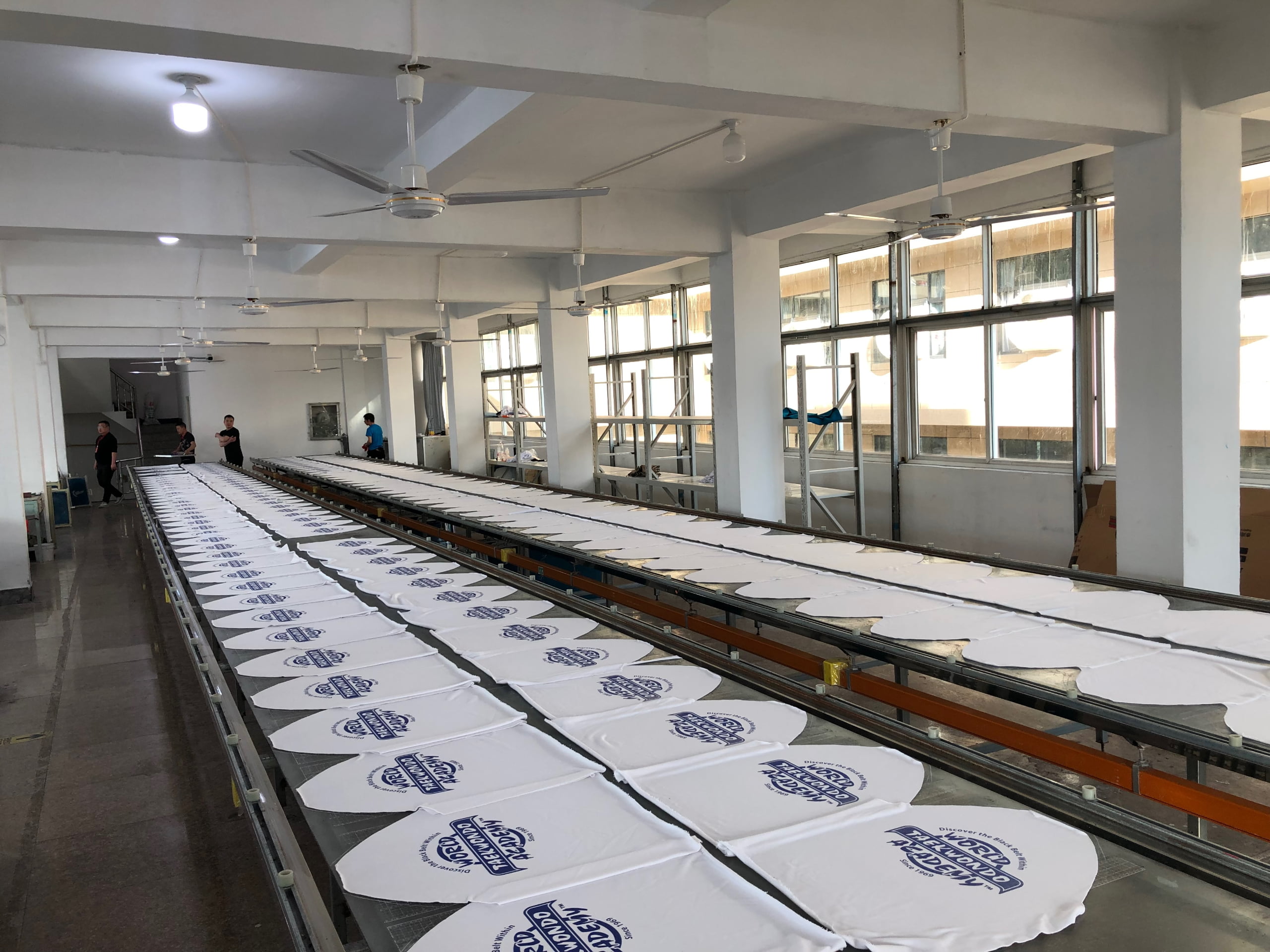
Typical process:
- Separate the artwork by color
- Prepare and expose the screens
- Set up and register the screens on the printing press
- Push ink through the screens onto the garment
- Cure the ink using heat
Because much of the setup work is completed before production begins, screen printing generally becomes more efficient as order quantity increases.
Advantages:
- Efficient for medium and large production runs
- Strong, opaque colors
- Works well on both light and dark garments when the correct ink system is used
- Suitable for many cotton and cotton-blend T-shirts
- Supports specialty effects such as puff, metallic, reflective, and high-density printing
- Can provide excellent durability when properly printed and cured
Limitations:
- Requires setup before production
- Additional colors can increase setup time and cost
- Very small orders may not be economical
- Complex photographic artwork usually requires more specialized separation and printing techniques
- Hand feel can vary depending on the ink, artwork, print area, and ink deposit
Best for: Bulk orders, brand graphics, promotional T-shirts, event merchandise, and designs where consistent color and production efficiency are important.
2. DTF (Direct-to-Film)
How it works
DTF printing first prints the artwork onto a special film. A hot-melt adhesive powder is applied to the printed design, and the transfer is then cured before being heat-pressed onto the garment. This basic DTF workflow is also described in Epson’s guidance on DTFilm garment printing.
Typical process:
- Prepare the digital artwork
- Print the design onto DTF film
- Apply adhesive powder
- Cure the printed transfer
- Heat-press the transfer onto the T-shirt
- Remove the carrier film according to the transfer system being used
Unlike screen printing, DTF does not require a separate screen for every color. This makes it particularly useful for detailed, multicolor designs and smaller production runs.
Advantages:
- Handles detailed and full-color artwork well
- Works on a wide range of fabrics, including cotton, polyester, and many blends
- Suitable for light and dark garments
- No screen setup is required
- Practical for samples, smaller orders, and designs with many colors
Limitations:
- The printed area sits on the surface of the fabric and can feel less breathable than some direct-print methods
- Large solid designs may feel heavier on the garment
- Transfer quality depends heavily on correct temperature, pressure, curing, and materials
- For large quantities of relatively simple artwork, screen printing may offer better production efficiency
Best for: Small and medium runs, detailed logos, multicolor artwork, samples, custom orders, and projects involving different garment fabrics.
3. DTG (Direct-to-Garment)
How it works
DTG uses an inkjet-style printer to print the artwork directly onto the garment. The ink is then cured so that the print can withstand normal use and washing.
Dark garments generally require pretreatment and a white ink base before the color layers are printed.
Typical process:
- Prepare the artwork
- Pretreat the garment when required
- Load the T-shirt onto the printer
- Print the design directly onto the fabric
- Heat-cure the print
Advantages:
- Excellent for detailed artwork, gradients, and photographic designs
- No screens are required
- Suitable for samples and low-volume customization
- Can produce a relatively soft print, particularly on suitable cotton garments
- Allows easy changes between different digital designs
Limitations:
- Works best on suitable cotton-rich garments
- Dark garments normally require pretreatment
- Production speed and unit economics can become less attractive for large-volume orders
- Results depend strongly on fabric quality, pretreatment, ink, curing, and printer setup
Best for: Samples, small runs, print-on-demand products, photographic artwork, illustrations, and complex full-color designs.
4. Heat Transfer
How it works
Heat transfer uses heat and pressure to bond a prepared graphic or material to the garment. The exact process depends on the type of transfer being used. Examples include transfer vinyl, printed transfers, specialty films, and foil effects.
Typical process:
- Prepare or print the transfer
- Position it on the garment
- Apply the specified temperature, pressure, and pressing time
- Remove the carrier according to the transfer instructions
Advantages:
- Low setup requirements
- Suitable for small quantities and personalization
- Can reproduce complex or multicolor artwork depending on the transfer system
- Useful for names, numbers, metallic effects, and specialty finishes
- Works with a variety of garment types when the transfer is matched correctly to the fabric
Limitations:
- Some transfers can feel heavier or more plastic-like than direct printing
- Large print areas can reduce breathability
- Incorrect pressing conditions can cause poor adhesion, lifting, or damage to the garment
- Different fabrics require different transfer materials and pressing conditions
Best for: Personalization, names and numbers, small batches, specialty effects, and projects where low setup requirements are important.
5. Sublimation
How it works
Sublimation uses heat to convert special dyes into gas so that the color bonds with polyester fibers. Instead of leaving a layer of ink sitting on top of the garment, the design becomes part of the fabric.
Typical process:
- Print the artwork onto sublimation transfer paper
- Position the transfer on the polyester fabric or garment
- Apply heat and pressure
- Allow the sublimation dye to bond with the polyester fibers
Advantages:
- Very soft hand feel because there is no heavy print layer on the surface
- Excellent for gradients, photographs, and full-color artwork
- Suitable for large or all-over designs
- Particularly useful for polyester sportswear and performance garments
Limitations:
- Best suited to polyester or polyester-rich materials
- Works best on white or light-colored fabric because standard sublimation does not print an opaque white layer
- Not the normal choice for conventional cotton T-shirts
Best for: Polyester sportswear, performance T-shirts, full-color designs, all-over prints, and lightweight garments where a soft hand feel is important.
6. Embroidery
How it works
Embroidery uses computerized machines to stitch thread directly into the garment. Before production, the artwork is converted into a stitch file through a process known as digitizing.
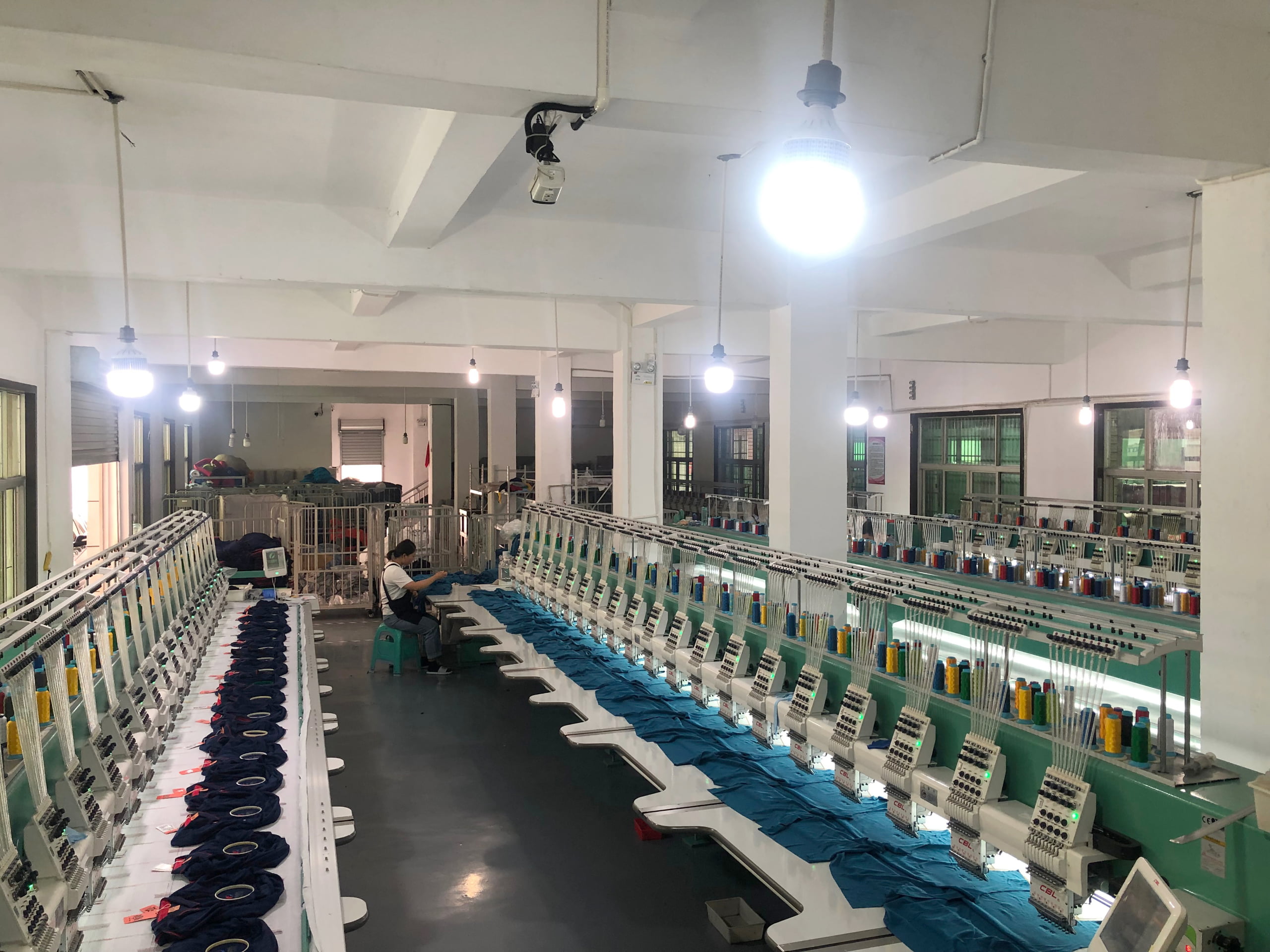
Typical process:
- Digitize the artwork
- Select and match thread colors
- Stabilize and hoop the garment
- Machine-stitch the design
- Trim excess thread and backing
- Inspect the finished embroidery
Advantages:
- Premium, dimensional appearance
- Very durable when correctly produced
- Excellent for small chest logos and corporate branding
- Works well on polos, jackets, caps, uniforms, and heavier garments
- No risk of a printed graphic peeling from the garment surface
Limitations:
- Artwork must be digitized before production
- Very fine details, tiny text, and smooth photographic gradients are difficult to reproduce
- Large embroidered areas can become heavy and stiff
- Lightweight or highly stretchy T-shirts may require careful stabilization
Best for: Small logos, corporate apparel, uniforms, polos, premium branding, caps, jackets, and designs where a stitched finish is preferred.
III. T-Shirt Printing Methods Comparison
No printing method is automatically better than all the others. The right choice depends on what you are producing.
| Method | Best Suited To | Artwork | Fabric | Typical Hand Feel | Order Consideration |
|---|---|---|---|---|---|
| Screen Printing | Bulk production, brand graphics, promotional tees | Simple to moderately complex; advanced techniques can handle more complex artwork | Cotton and many blends | Varies with ink and print coverage | Becomes more efficient as volume increases |
| DTF | Detailed multicolor designs and flexible production | Full color, fine details, gradients | Cotton, polyester and many blends | Transfer layer on fabric | Useful for small to medium runs and mixed designs |
| DTG | Samples, POD and detailed artwork | Photos, gradients, illustrations | Best on suitable cotton-rich garments | Generally soft, depending on garment and pretreatment | Well suited to low-volume customization |
| Heat Transfer | Personalization and specialty finishes | Depends on transfer system | Varies by transfer material | Usually noticeable on fabric | Low setup makes small runs practical |
| Sublimation | Sportswear and all-over designs | Full color, photos, gradients | Polyester, especially white or light colors | Very soft | Excellent when fabric and design suit the process |
| Embroidery | Premium logos and corporate apparel | Clean logos, text and icons | Many stable garment fabrics | Raised and textured | Cost is influenced by stitch count, size and complexity |
The table should be treated as a starting point rather than a strict rule. The same design can sometimes be produced successfully using several methods, and the final choice may depend on the garment, artwork, order quantity, target price, and desired appearance.
IV. How to Choose the Best T-Shirt Printing Method
Instead of choosing a process based on one factor alone, evaluate the project in the following order.
Step 1: Look at Your Artwork
Start with the design itself.
- Simple logos and bold spot colors: Screen printing is often a strong option.
- Detailed multicolor graphics: DTF or DTG may be easier to produce.
- Photographic artwork and gradients: DTG, DTF, or sublimation may be appropriate depending on the fabric.
- Small premium logos: Embroidery may provide the desired appearance.
- Names, numbers, metallic effects, or specialty applications: Heat transfer may be worth considering.
Do not simplify a complex design just to force it into a production method that does not suit the artwork. In many cases, it makes more sense to select the process after reviewing the actual design file.
Step 2: Consider Order Quantity
Quantity affects production economics, but there is no universal quantity at which one method suddenly becomes better than another.
Screen printing requires more setup, so its economics generally improve as the number of identical prints increases. Digital and transfer-based methods require less traditional setup, making them useful for samples, smaller orders, personalization, or designs that change frequently.
The crossover point depends on factors such as:
- Number of print colors
- Artwork complexity
- Print size
- Garment type
- Number of different designs
- Required production speed
- Local labor and production costs
For this reason, it is better to compare actual production quotations than rely on a fixed rule such as “screen printing only makes sense above 500 pieces.”
Step 3: Check the Fabric
The garment itself can eliminate some options immediately.
- Cotton and cotton-rich T-shirts: Screen printing and DTG are common choices, while DTF can also work well.
- Polyester and performance fabrics: Sublimation can be an excellent choice when the fabric and garment color are suitable. DTF and appropriate screen-printing systems are also possible.
- Blended fabrics: The exact fiber composition should be checked before selecting the process.
- Lightweight or stretchy garments: Large embroidery areas may distort the fabric, so stabilization and design size become important.
For polyester garments, production testing can be especially important because high heat and certain printing processes may create dye migration or other color-related problems. STAHLS’ Dye Migration Handbook explains how polyester type, garment color, heat, and other production variables can affect dye migration.
Step 4: Think About the Finished Experience
Ask what you want the customer to feel when they receive and wear the T-shirt.
- Premium stitched branding: Embroidery
- Classic printed T-shirt appearance: Screen printing
- Detailed digital artwork: DTG or DTF
- Very soft polyester print: Sublimation
- Names, numbers, or specialty effects: Heat transfer
Print size matters here as well. A small DTF chest logo and a large DTF graphic covering most of the front of a shirt will not feel the same, even though both use the same basic printing method.
Step 5: Compare Total Cost, Not Just Printing Price
The cheapest printing price is not always the lowest-cost solution for the finished product.
Consider:
- Artwork preparation and setup
- Sampling cost
- Garment cost
- Printing or embroidery cost
- Reject and rework risk
- Production time
- Packaging requirements
- Required quality level
For brands placing production orders, the best decision is usually the method that delivers the required appearance and durability at an acceptable total cost—not simply the process with the lowest decoration price.
V. Which T-Shirt Printing Method Should You Choose?
Here is a simple starting point:
- Choose screen printing when you have repeatable artwork and production volume makes the setup worthwhile.
- Choose DTF when you need detailed full-color artwork, fabric flexibility, or relatively low setup requirements.
- Choose DTG for detailed digital artwork, samples, print-on-demand products, and smaller runs on suitable garments.
- Choose heat transfer for personalization, names, numbers, specialty effects, or applications suited to transfer materials.
- Choose sublimation for suitable polyester garments, especially sportswear and large full-color designs.
- Choose embroidery when you want a premium stitched logo and the garment is suitable for embroidery.
These are guidelines, not fixed production rules. If two methods both appear suitable, producing a sample is often the safest way to compare appearance, hand feel, color, and overall garment quality before bulk production.
VI. Care and Durability
Durability depends not only on the printing method but also on the quality of the materials, pretreatment, curing, pressing conditions, garment fabric, washing method, and production control.
For most decorated T-shirts, the following care practices can help protect the design:
- Follow the garment’s care label
- Wash printed garments inside out when appropriate
- Avoid unnecessarily aggressive washing conditions
- Avoid ironing directly over heat-sensitive printed areas
- Use drying temperatures appropriate for the garment and decoration
For commercial orders, always confirm the specific care requirements of the selected printing system rather than assuming that every screen print, transfer, or digital print should be treated identically.
VII. Final Takeaways
There is no single best T-shirt printing method for every project.
Screen printing may be the right choice for one bulk order, while DTF or DTG may make more sense for another design. Sublimation can be ideal for polyester sportswear but unsuitable for a conventional dark cotton T-shirt. Embroidery can create a premium logo but may be uncomfortable when used across a large area of lightweight fabric.
The best way to choose is to look at five things together:
- Your artwork
- Your order quantity
- Your garment fabric
- The look and hand feel you want
- Your total production cost
If you are sourcing custom T-shirts from a manufacturer, send the supplier your artwork, fabric requirements, quantity, garment color, print dimensions, and expected finish. An experienced supplier should be able to recommend suitable production methods and explain the trade-offs before you approve a sample.
If you are planning to sell branded T-shirts online rather than place a one-off order, read our guide on how to start an online T-shirt store.
Choosing the printing method before bulk production—and confirming it with an actual sample when necessary—can help you avoid unnecessary cost, quality problems, and disappointing results.